Table of Contents
NetDocuments is a capable, cloud-based document management system, and for some law firms it’s a perfectly reasonable choice. For others, the cost keeps climbing, the interface feels dated, and the Windows-first reality grates on a Mac-using team.
This review gives you a straight read: what NetDocuments does well, where firms get frustrated, and how to decide whether to stay on it or start looking.
If you’re weighing it against other options, our guide to the best legal document management software covers the wider field. Here’s the honest version.
NetDocuments at a Glance
NetDocuments is a mature, true-cloud DMS that suits Windows-first firms wanting an established, enterprise-style platform, though its opaque pricing, dated interface, and reduced Mac experience push many law firms to look elsewhere.
It’s one of the older names in legal document management, and that cuts both ways. The platform is deep, secure, and proven across thousands of firms. It also carries the weight of its age in the interface and the way it gets sold and implemented.
Here’s the quick read before the details:
If that profile matches your firm, NetDocuments is worth a look. If it doesn’t, the rest of this review will show you why.
What NetDocuments Is and Where It Came From
NetDocuments launched in 1999 as one of the first cloud-based document management platforms, and it’s now a mature, multi-industry system used by law firms, financial services, and corporate legal teams. It was built for the cloud before “the cloud” was the default, which gives it a genuine claim to being a true cloud DMS rather than a server product with remote access added later.
The platform has been refined over more than two decades, and it shows in the depth of the feature set. The age shows elsewhere too, in an interface and a sales model that feel like they belong to an earlier era.
NetDocuments sits closer to the legacy DMS end of the spectrum. It’s privately held, owned by private-equity firms Warburg Pincus and Cove Hill Partners, and it has grown through acquisitions, including Worldox in 2022 and eDOCS in 2025.
NetDocuments Features for Law Firms
NetDocuments covers the core feature set law firms expect from a DMS, with a couple of areas where law firms notice friction. The essentials are all there: document storage, full-text search, version management, Microsoft 365 integration, email management, profiling and tagging, OCR, and security controls.
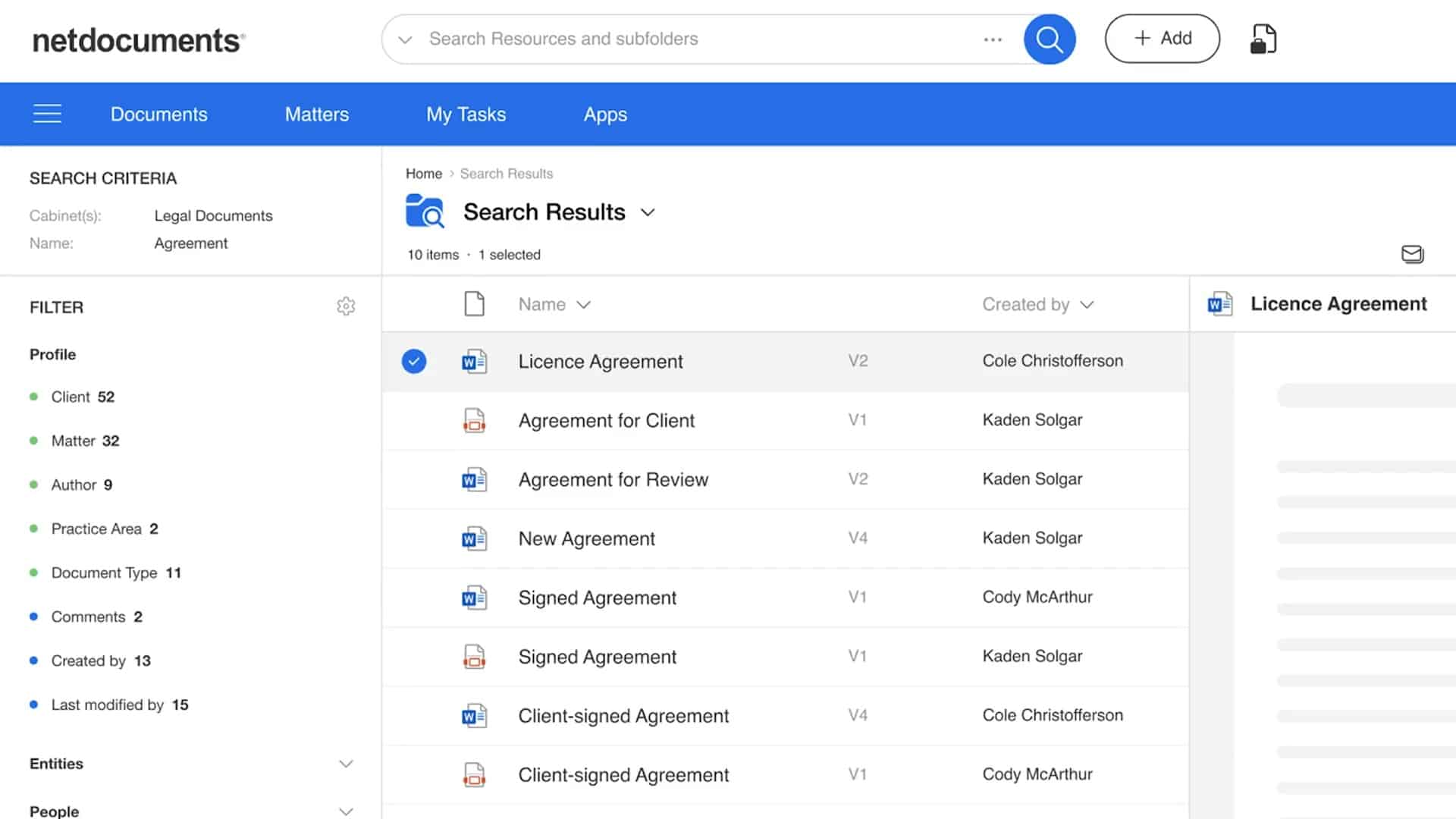
The platform organizes documents into matter-centric workspaces and uses a profiling system to tag and retrieve files. It integrates with Office through ndOffice on Windows, and with Outlook through ndMail on Windows; on a Mac or the web, email is filed with its Microsoft 365 Outlook add-in, which needs an ndMail subscription.
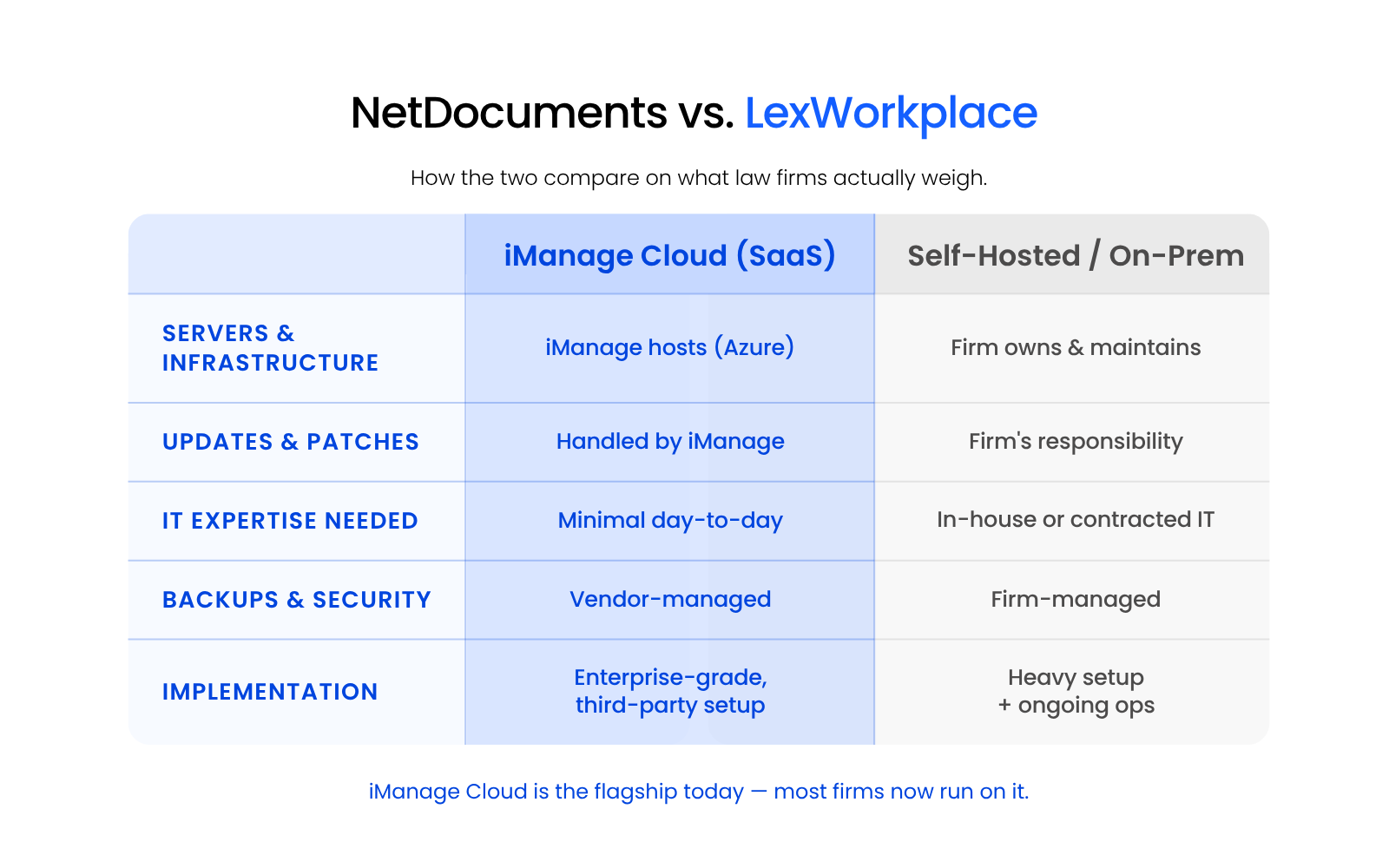
Here’s how NetDocuments lines up against LexWorkplace on the dimensions law firms actually weigh:
The feature gaps that surprise firms most are the Mac experience and the cost model, both of which are worth a closer look below.
Where NetDocuments Earns Its Place
NetDocuments is a genuinely strong choice for firms that want a true-cloud system with no server to maintain, a deep and mature feature set, and a platform proven across thousands of organizations. The honest case for it is real, and it’s worth stating plainly before the criticisms.
A few things NetDocuments does well:
For a Windows-first firm with IT support and a budget that fits, these strengths add up to a defensible choice. The question is whether the friction below outweighs them for your firm.

What NetDocuments Users Actually Say
Across independent review sites and legal-tech communities, NetDocuments users consistently praise its capability and security while criticizing a dated, sometimes slow interface and rising costs. The pattern is steady enough to take seriously.
| What Users Tend to Praise | What Users Tend to Criticize |
|---|---|
| The depth and reliability of the platform once it’s set up | An interface that feels dated and, at times, slow to work in |
| Strong security and compliance handling | Costs that climb at renewal, often without clear justification |
| The confidence that comes with a long-established vendor | A setup and support experience that depends heavily on the assigned reseller |
This feedback shows up repeatedly on peer review platforms and in legal-technology communities. None of it makes NetDocuments a bad product. It does explain why a steady stream of firms start looking at alternatives, usually for the same two reasons: the cost and the day-to-day experience.
Where NetDocuments Frustrates Law Firms
The most common law-firm frustrations with NetDocuments are rising and opaque pricing, a dated interface, a reduced Mac experience, mandatory third-party implementation, and workspaces that need configuring rather than a native client/matter model. These are the issues that move firms from “it works” to “we’re looking.”
Cost is usually first. NetDocuments doesn’t publish pricing, and firms regularly report increases at renewal that arrive without much explanation. When the price keeps climbing and the interface feels stuck in place, the value question gets harder to answer every year.
The interface is the second recurring complaint. The platform is powerful, and it carries its age, so attorneys who’ve used a modern tool notice the difference in how many clicks it takes to do ordinary work.
Then there’s the Mac experience. NetDocuments runs on a Mac in the browser and through ndClick, but ndOffice, its Office integration, is Windows-only, so Mac-heavy firms should confirm exactly what’s supported before committing.
Onboarding is the next issue, and it’s structural. NetDocuments routes migration and training through third-party resellers rather than handling it directly. Firms that have had a rough handoff know how much the assigned consultant’s product knowledge can make or break the experience.
Finally, NetDocuments organizes documents into configurable, matter-centric workspaces that your firm sets up, rather than assuming a native client/matter structure out of the box. Firms can make it work well, though it’s a setup task rather than a default.
Should You Switch Away From NetDocuments?
You should consider switching away from NetDocuments if your firm faces a renewal price increase, runs Macs, wants a single vendor for IT and document management, needs native client/matter organization, or is frustrated with reseller-based support. Any one of those can be the trigger. Often it’s several at once.
The firms that leave tend to hit a breaking point first: people overwriting each other’s documents, email scattered across everyone’s Outlook folders, and the recurring complaint that nobody can find anything. The system technically works, and the friction has become a daily tax on the firm’s time.
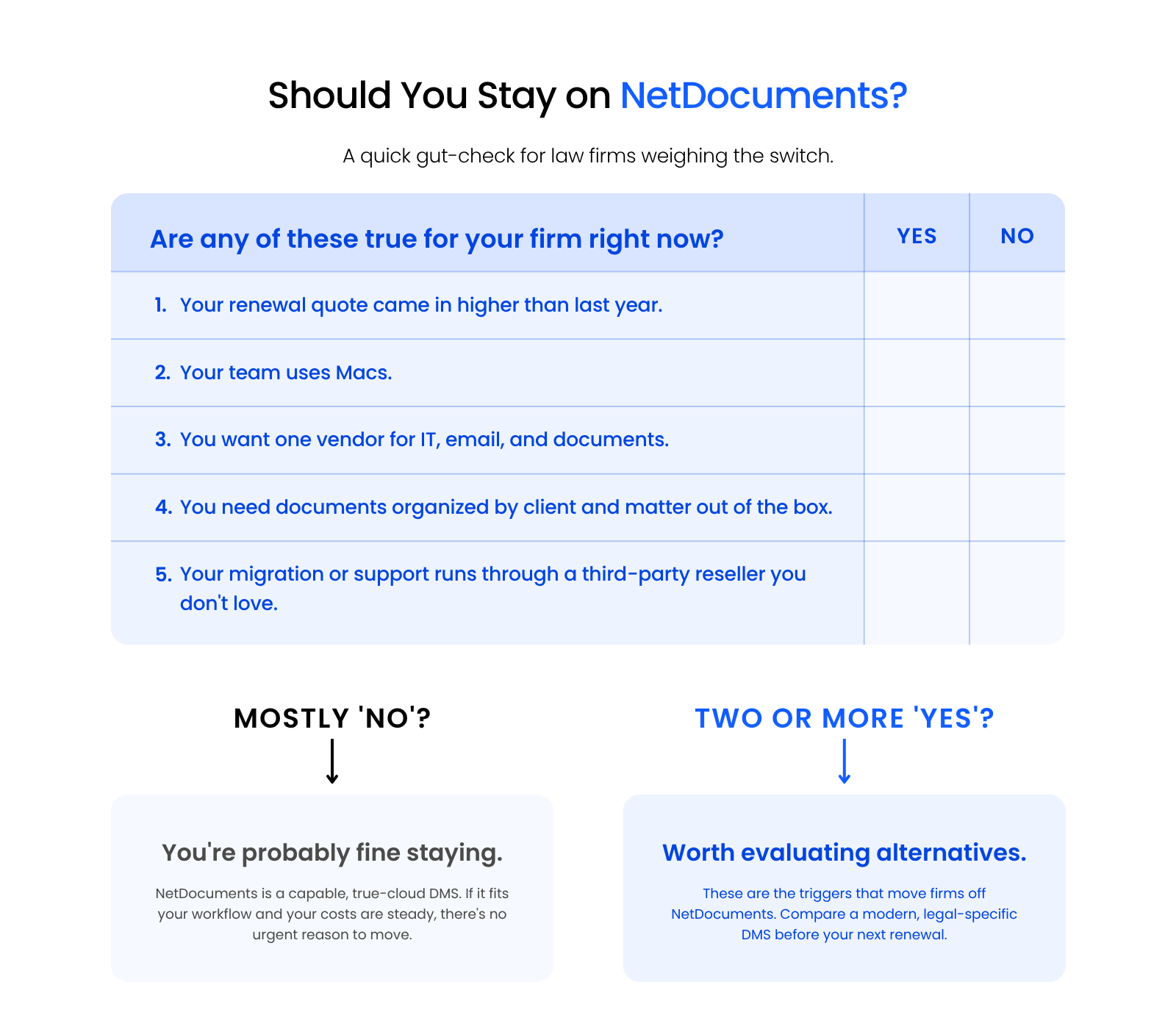
Here’s a practical way to read your own situation:
If your firm is hitting those triggers, the reasons firms leave NetDocuments are worth understanding in detail before your next renewal. The next two sections cover what NetDocuments actually costs and how the main alternatives compare.
What NetDocuments Costs
NetDocuments does not publish its pricing. Reported figures from current users and consultants point to roughly $50 to $65 per user per month, usually with a three- or five-user minimum, plus separate third-party implementation fees and add-ons like ndOffice, ndMail, and OCR.
The bigger issue than any single number is the lack of transparency. You can’t get a clear price from a public page. You go through a reseller, get a quote tied to your user count and configuration, and then negotiate. For a busy firm administrator trying to budget, that opacity is a real cost in itself.
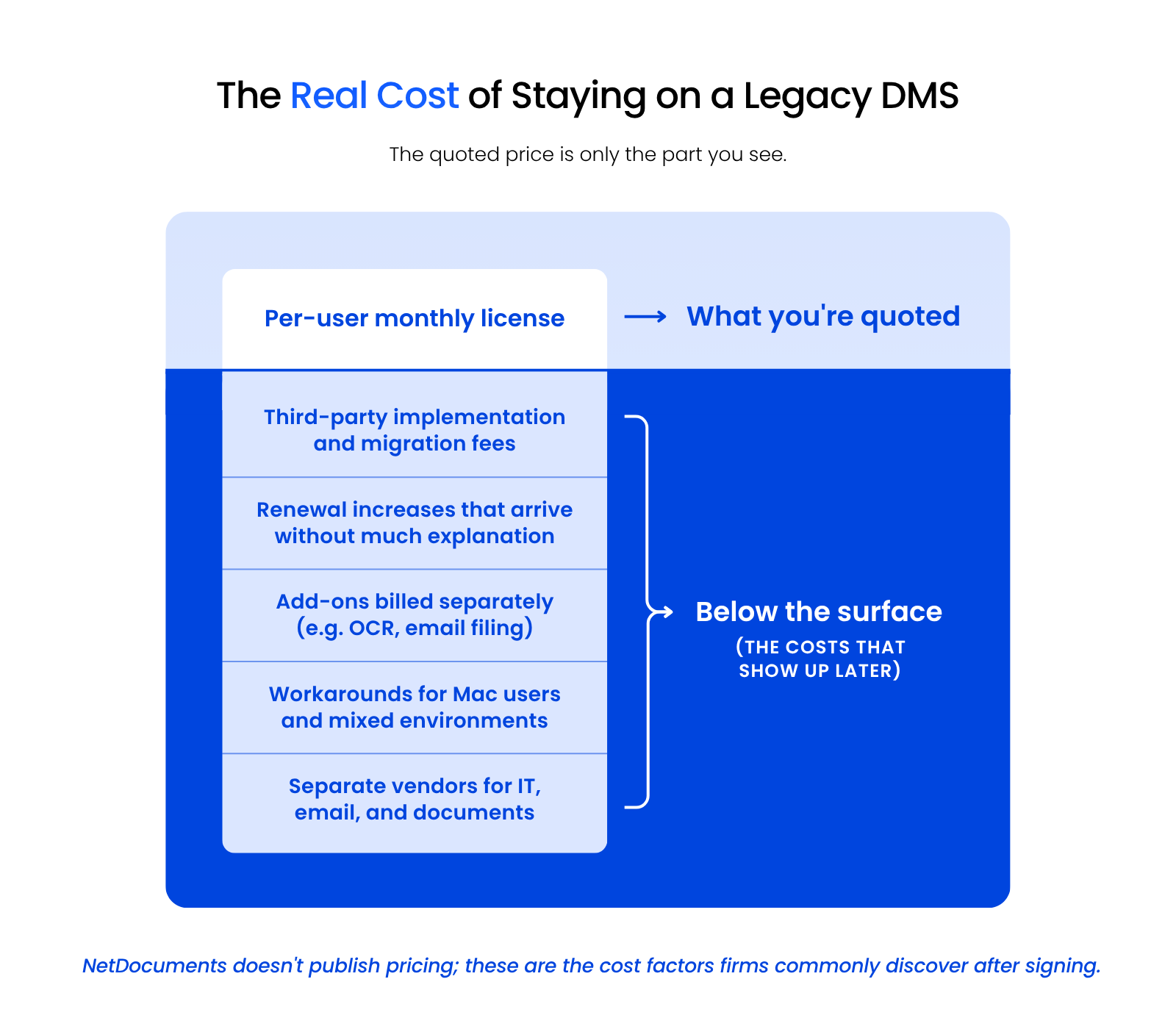
The reported increases at renewal are what tip many firms into looking elsewhere. When the original quote was already hard to pin down and the renewal comes in higher, the total cost of staying starts to feel uncertain in a way that published-pricing tools avoid. Our full breakdown of NetDocuments pricing digs into the reported numbers and what drives them.
NetDocuments vs. the Alternatives
The main alternatives to NetDocuments for law firms are LexWorkplace, iManage, SharePoint, and the now-discontinued Worldox, and each fits a different kind of firm. The right comparison depends on what’s pushing you to look in the first place.
| Platform | Deployment | Windows + Mac | Client/Matter | Onboarding | Pricing |
|---|---|---|---|---|---|
| NetDocuments | True cloud | Windows full, Mac reduced | Configurable workspaces | Third-party reseller | Not published; reported ~$50–65/user/mo |
| LexWorkplace | True cloud | Native both | Native | In-house | From $395/mo for 3 users |
| iManage | Cloud or on-prem | Varies | Workspaces | Reseller partner | Not published; reported ~$50–75/user/mo |
| SharePoint | Cloud | Both via M365 | None, unless configured | DIY / consultant | Bundled in M365 from ~$6/user/mo |
| Worldox | Premise-based | Windows | Profile-based | Reseller | Being discontinued |
A side-by-side comparison of these options is the fastest way to see where each one fits. For firms specifically weighing a move off NetDocuments, our list of NetDocuments alternatives goes deeper on each option.
NetDocuments Review: The Bottom Line for Your Firm
NetDocuments is a capable system, and if it fits your firm and the cost holds steady, there’s no urgent reason to move. The firms that outgrow it tend to share the same triggers: a Mac requirement, a renewal price hike, or the friction of third-party support and a dated interface.
If any of those sound like your firm, it’s worth seeing what a modern, legal-specific DMS feels like before your next renewal. The honest answer comes down to fit, cost, and how much friction your team is willing to carry.
WHAT’S NEXT