Table of Contents
If you’re comparing legal document management software, you’ve probably noticed that every vendor’s marketing sounds the same.
We’ll be upfront: LexWorkplace is our product. But that gives us something most review sites don’t. We’ve worked with hundreds of law firms evaluating and migrating DMS software, and we know what actually matters.
This guide gives you an honest comparison of the major legal document management software options, a clear recommendation, and a framework to make the right call. Whether you’re migrating off a legacy system, outgrowing your practice management software’s document module, or still running off a file server, start here.
Quick Comparison: Legal DMS at a Glance
Not every product in this list is a true document management system. Here’s how the major options compare before diving into the full reviews.
Clio, MyCase, Filevine, and SharePoint are included because they frequently come up in law firm DMS searches, but they’re primarily practice management or general-purpose tools, not dedicated DMS platforms.
For true DMS functionality, version control, document profiling, Outlook email management, and full-text search across document content, focus on LexWorkplace, iManage, and NetDocuments.

The Best Legal Document Management Software
The following reviews are organized by category. Find the tier that fits your firm’s size, structure, and needs, then review the relevant options in detail.

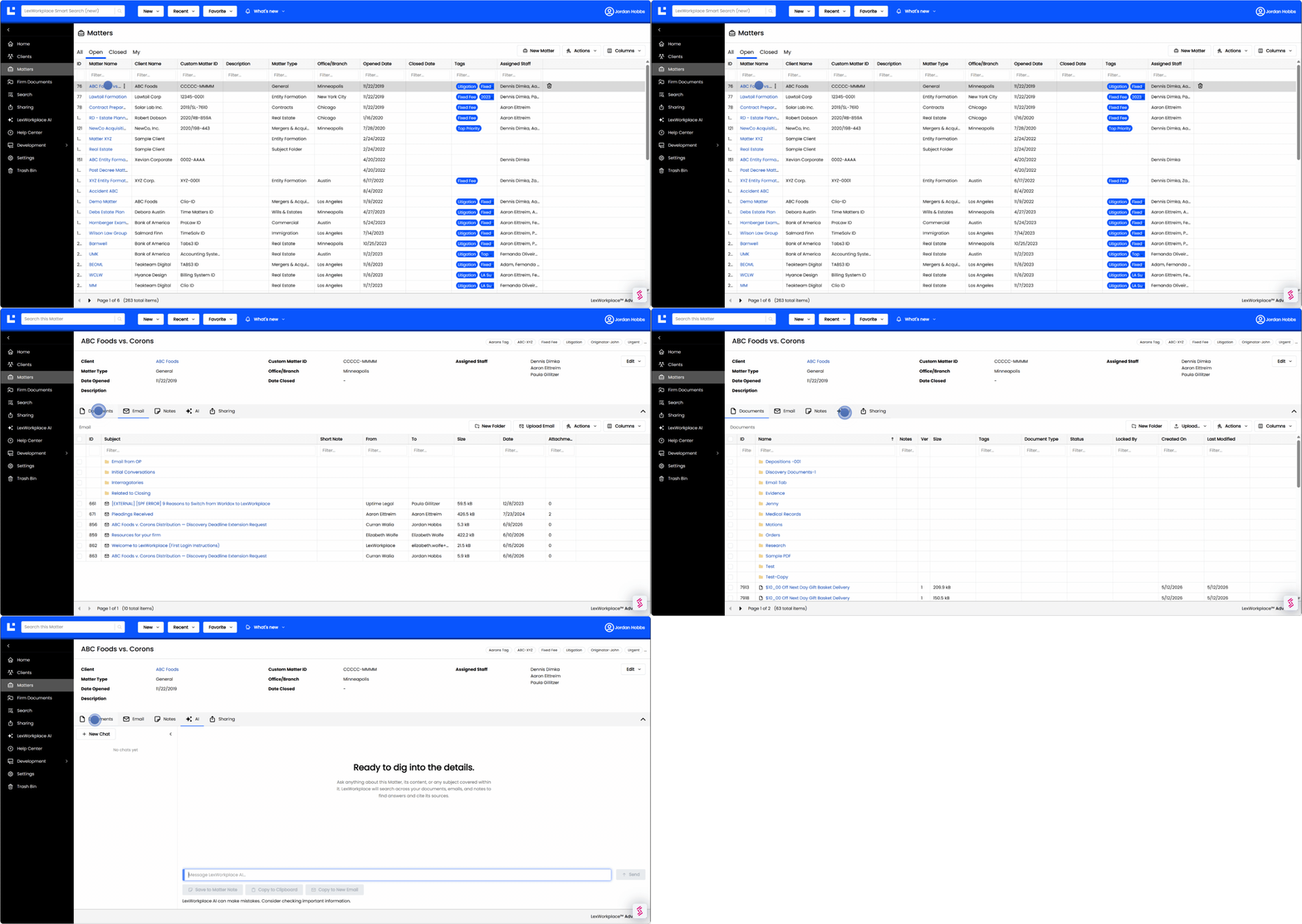
LexWorkplace is purpose-built for law firms, which means the defaults make sense for legal work without heavy configuration.
Matter-centric organization, Outlook email filing to matters, and AI-powered search are available out of the box, not add-ons that require a consultant to unlock. Document AI answers questions about a single document; Matter AI goes further and answers questions across an entire matter’s documents, email, and notes at once.
For firms on mixed Windows and Mac environments, native cross-platform support is a meaningful daily advantage: every attorney gets the same full-featured experience regardless of operating system.
Pricing is public and transparent, and our cost analysis and ROI breakdown walks through the full numbers. For firms coming off a legacy DMS, transitioning from a practice management document module, or migrating off a file server, LexWorkplace is the natural first option to evaluate.

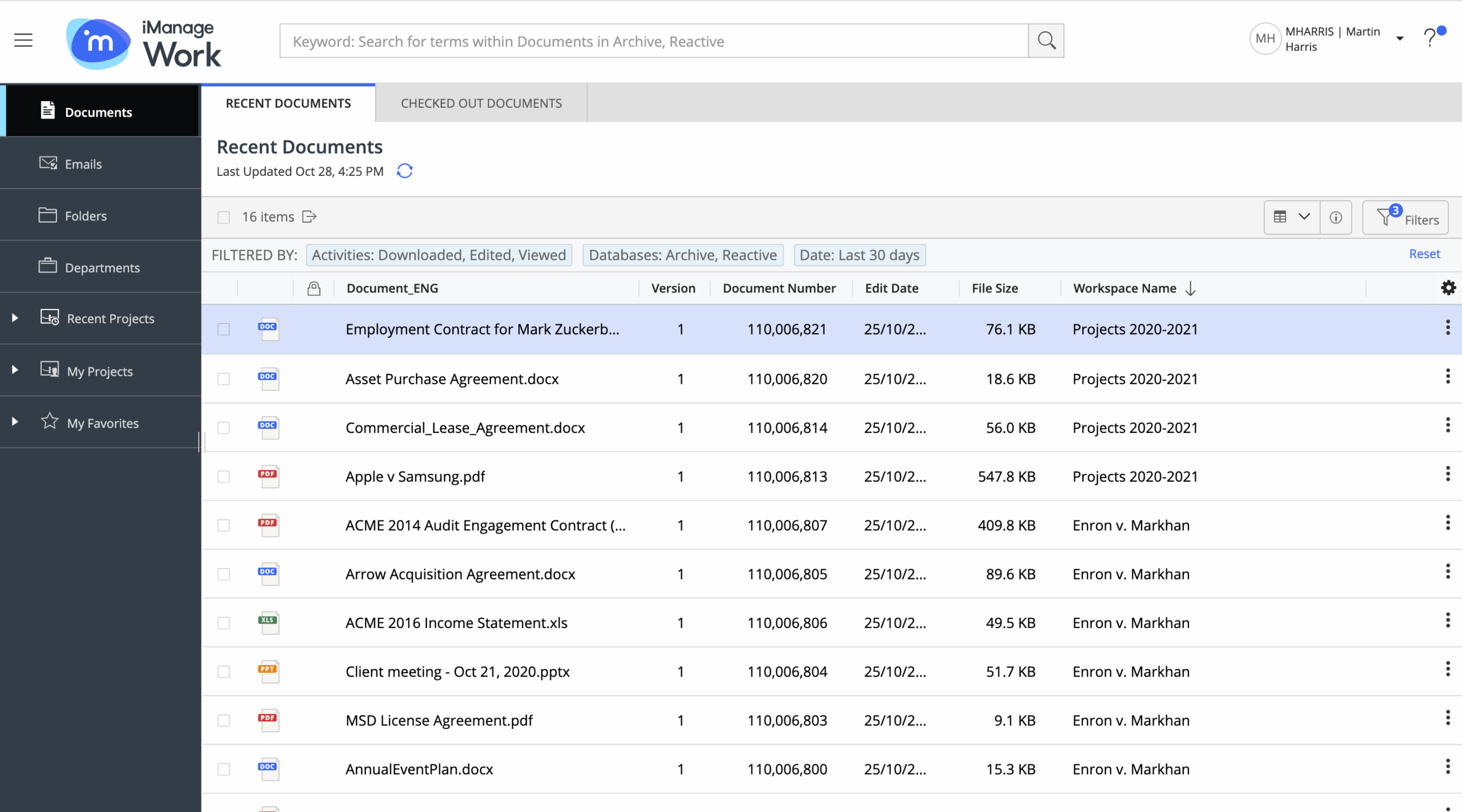
iManage is the enterprise standard for a reason. It handles scale, compliance complexity, and governance requirements that mid-market platforms don’t need to address, and its AI suite (Ask iManage, Insight+) is built for exactly that enterprise knowledge-management problem. For BigLaw, government practices, or large corporate legal departments, it’s a defensible choice with broad market acceptance.
For a 10-person general practice firm, the implementation complexity and reseller-only pricing model create significant friction before you can even evaluate it. If you’re at enterprise scale, evaluate it seriously. If you’re not, see our breakdown of iManage alternatives designed for smaller practices.
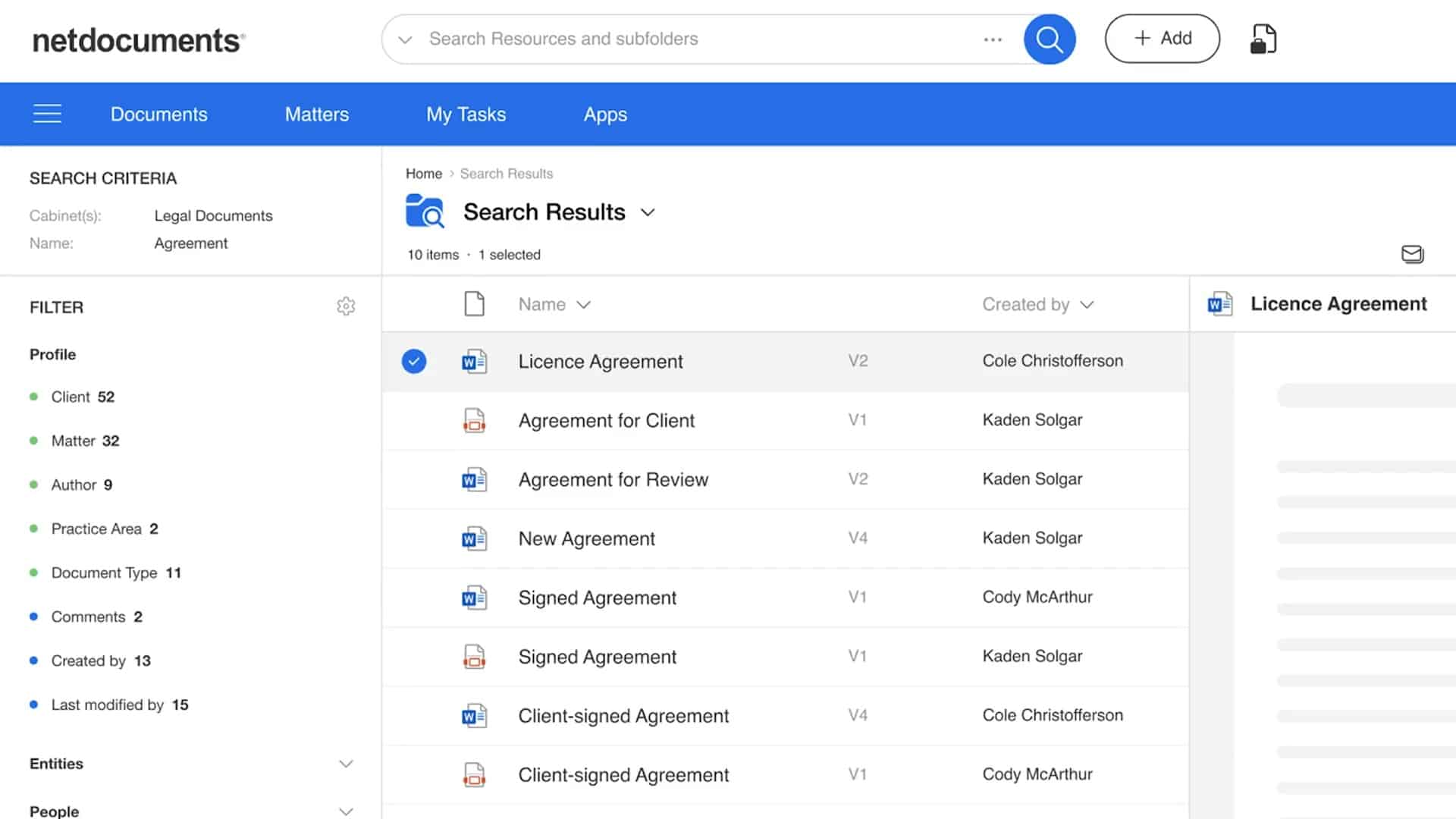
NetDocuments is a credible cloud DMS with a well-established compliance story, and its ndMAX AI suite gives it real document automation and analysis capability, though, like most enterprise platforms, the AI sits in higher tiers rather than across all plans.
Its strongest case is for Windows-only environments or organizations already embedded in the NetDocuments ecosystem. If any of your attorneys use Macs, they’ll experience a noticeably degraded daily experience compared to Windows users.
The 2022 acquisition of Worldox also makes NetDocuments the logical migration destination for firms currently on that platform. If that’s your situation, NetDocuments offers the most direct transition path and existing integrations. See our breakdown of NetDocuments pricing and what to expect.

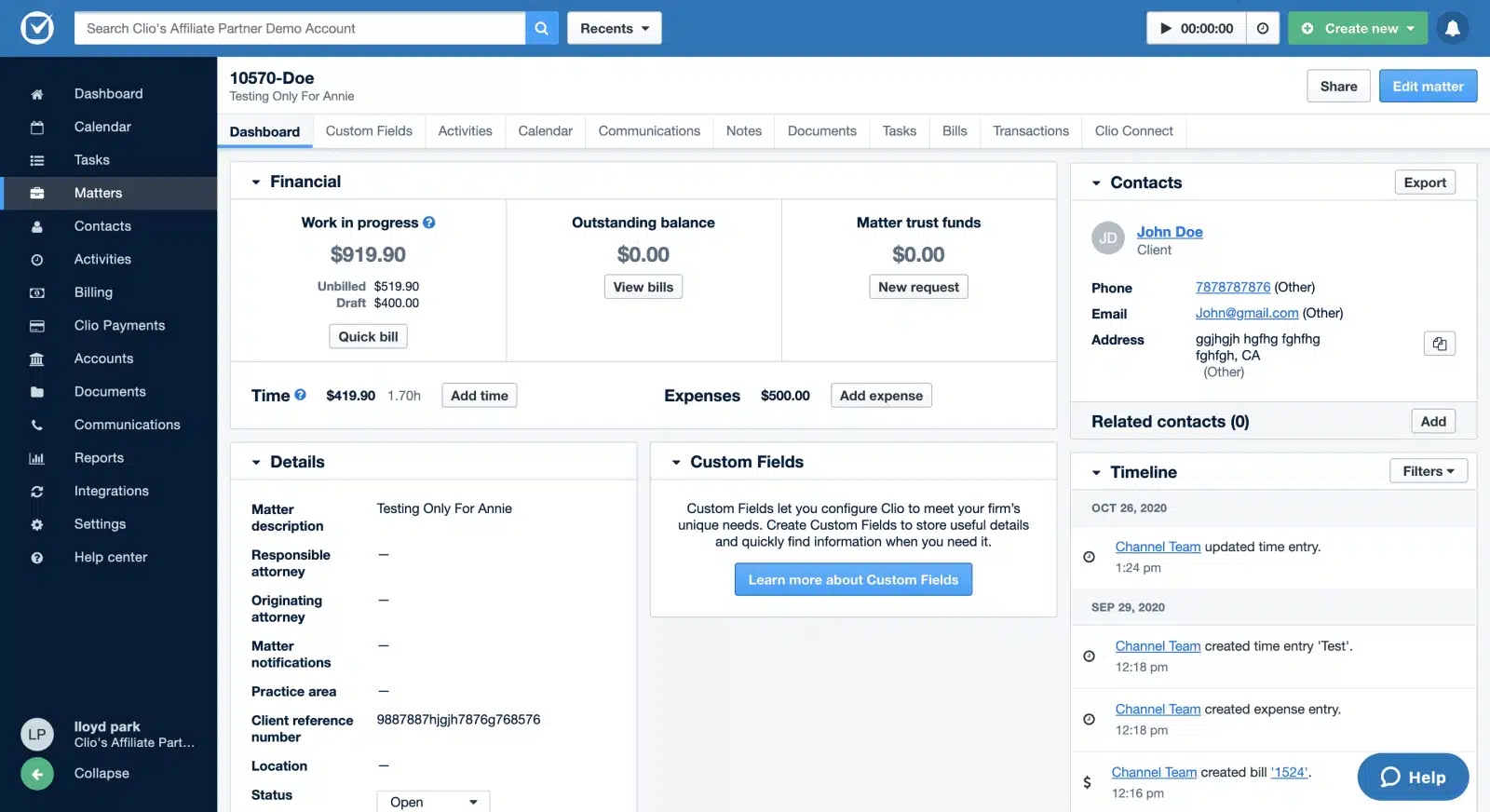
Clio is excellent practice management software, and its document module covers the basics well: file storage, full-text search, and version history. Where it runs out of runway is depth. There’s no document profiling, and no way to file emails to matters from within Outlook the way a dedicated DMS allows.
For firms whose document needs stay simple, that’s fine. For firms managing high document volume across many matters, the gap shows.
If you’re already on Clio Manage and your document complexity is low, it may be sufficient today. If your needs are growing, pairing Clio with a dedicated DMS is the typical next step. The two systems work alongside each other; they don’t have to be replaced together.
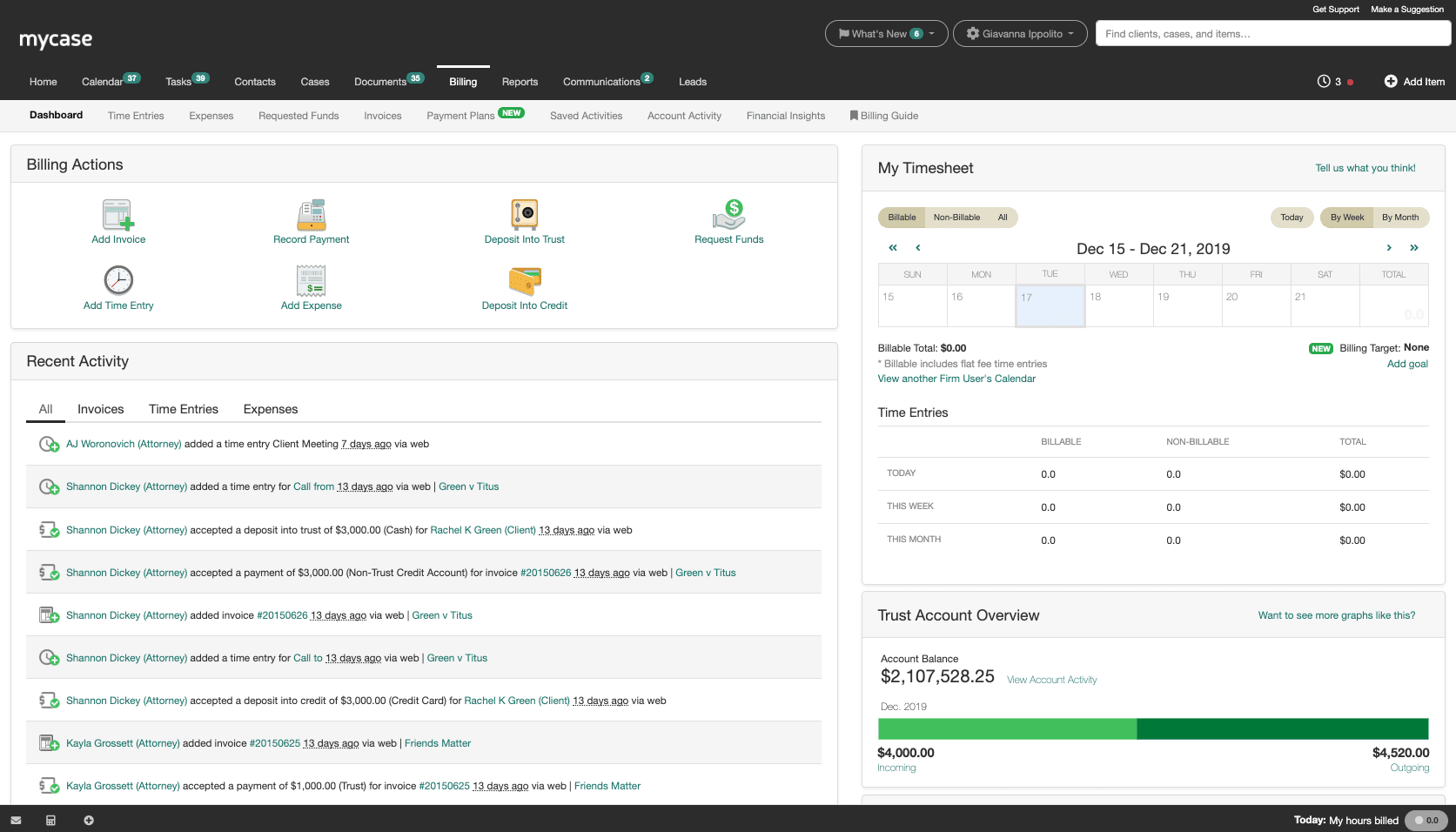
MyCase’s document module gives your firm a practical starting point for organizing files by matter, with version control and, on its Advanced tier, full-text search across document content.
Where it stops short of a dedicated DMS: no document profiling, no OCR, and no way to file emails to matters from within Outlook. Like Clio, it’s best understood as a document layer within the practice management stack. When your firm’s document needs grow, adding a dedicated DMS is the logical upgrade.

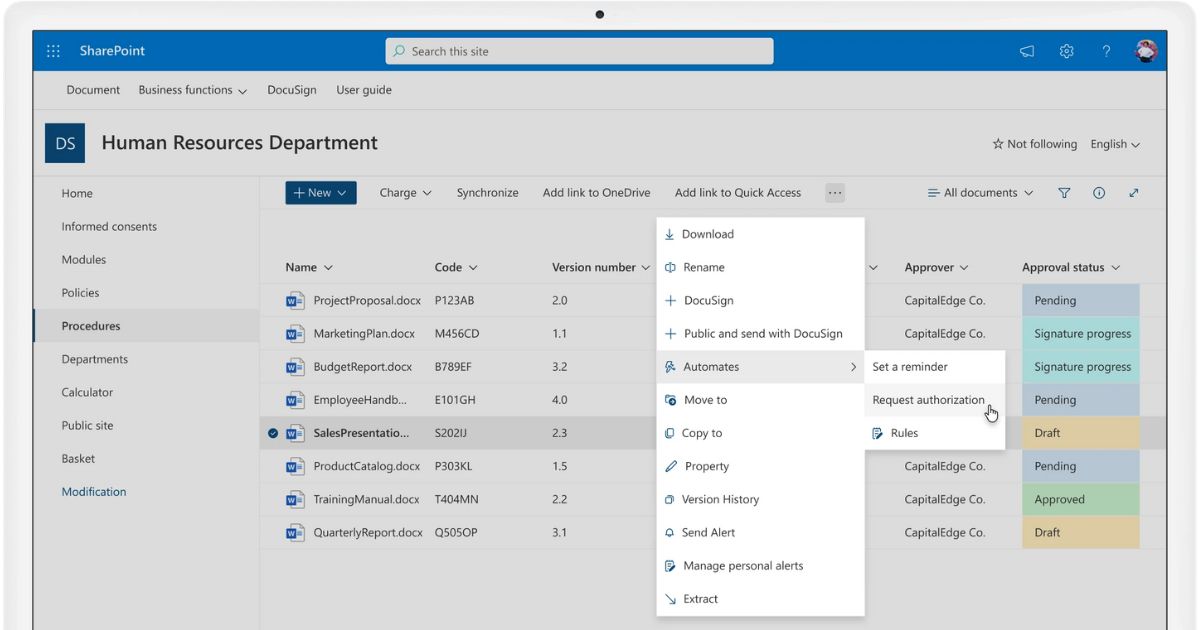
SharePoint is a collaboration and intranet platform. Without expert configuration, it has no matter-centric organization, no document profiling, and no legal-specific structure.
Building a legal DMS on SharePoint requires a specialist consultant, ongoing IT support, and user training that most firms don’t have the appetite for.
Firms that attempt this approach typically migrate off. Use it for internal collaboration and document storage within Microsoft 365, not as a replacement for a dedicated DMS.

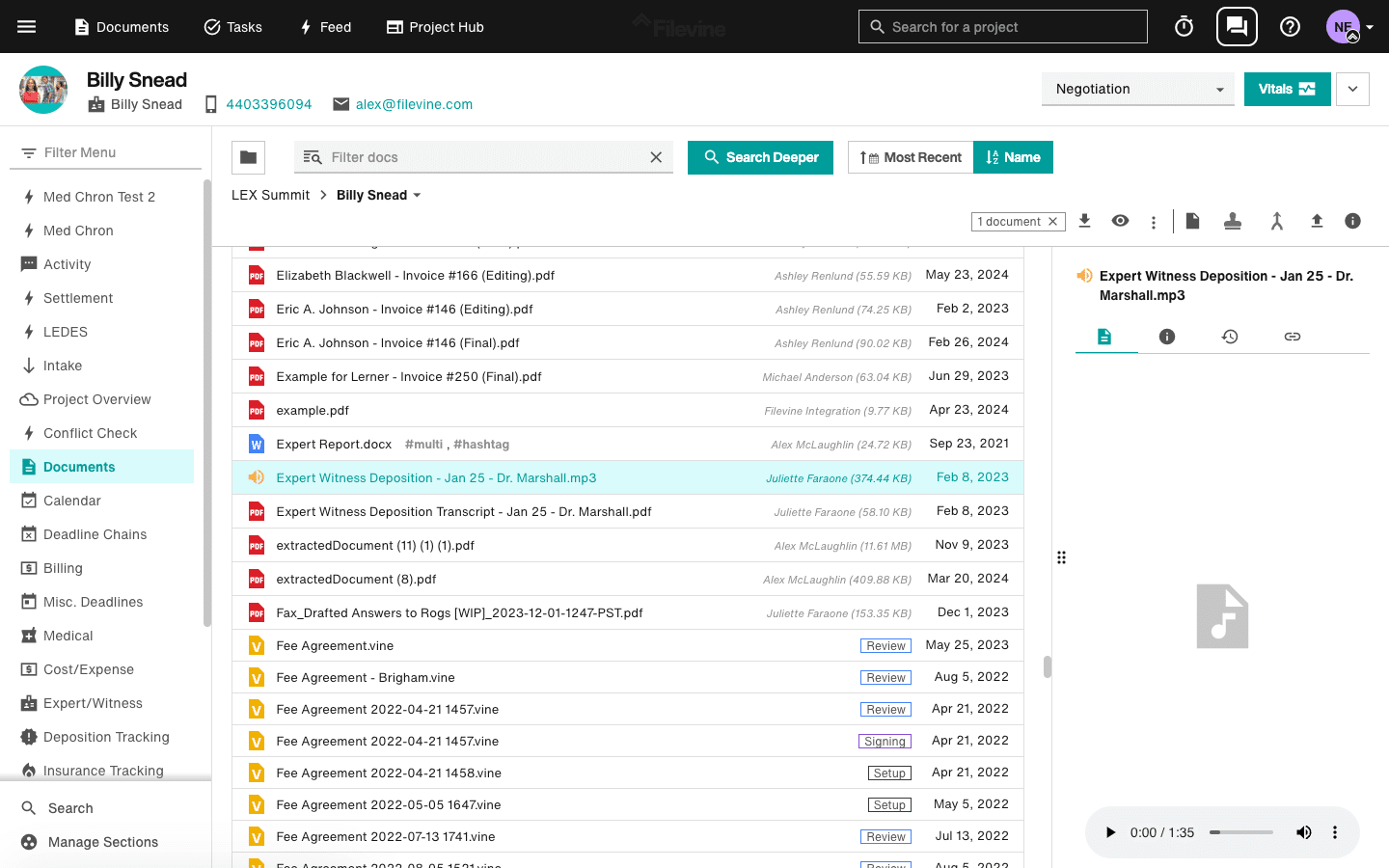
Filevine is a strong case management platform for litigation practices, and its document layer is more capable than most practice-management tools: it has version control, OCR-powered search, document locking, and a real AI layer in LOIS.
The catch is that document management is one module inside a case-management platform, not a standalone DMS, and getting full value out of it (especially the AI) often means additional configuration and add-on cost.
For firms where case workflow management is the primary need and document management rides alongside it, Filevine is worth evaluating. For firms where document management is the primary need, a dedicated DMS gives you that depth without building it around a case-management core, and without the per-module add-on spend.

Who This Guide Is For
If your team is wasting time searching across multiple systems, or relying on one person’s Outlook inbox to hold critical matter communications, this guide is for you.
More specifically, this guide is written for:
If any of these describe your firm, the comparison and evaluation framework in this guide will help you make the right call.
What Is Legal Document Management Software?
Legal document management software is purpose-built for organizing, storing, searching, and managing documents and email at a law firm, structured around how legal work actually happens, not how generic businesses store files.
The term “document management” gets applied to a lot of software that isn’t. Knowing what actually qualifies protects your firm from buying the wrong thing.
Here are the most common misconceptions:
The distinction matters when you’re comparing options. We’ll define what makes a DMS a DMS in the features section below.
Why Law Firms Need Document Management Software
Scattered content, documents on a file server, emails in individual inboxes, notes in the practice management system, is the operational problem a DMS solves.
When an associate needs to find the client’s approval from six weeks ago (was it in an email? A document attached to an email? A note in Clio?) they end up checking three places and sometimes don’t find it at all. That’s not a people problem.
Working with hundreds of law firms over the years, the single most common operational mistake I observe is keeping documents and emails in separate systems.
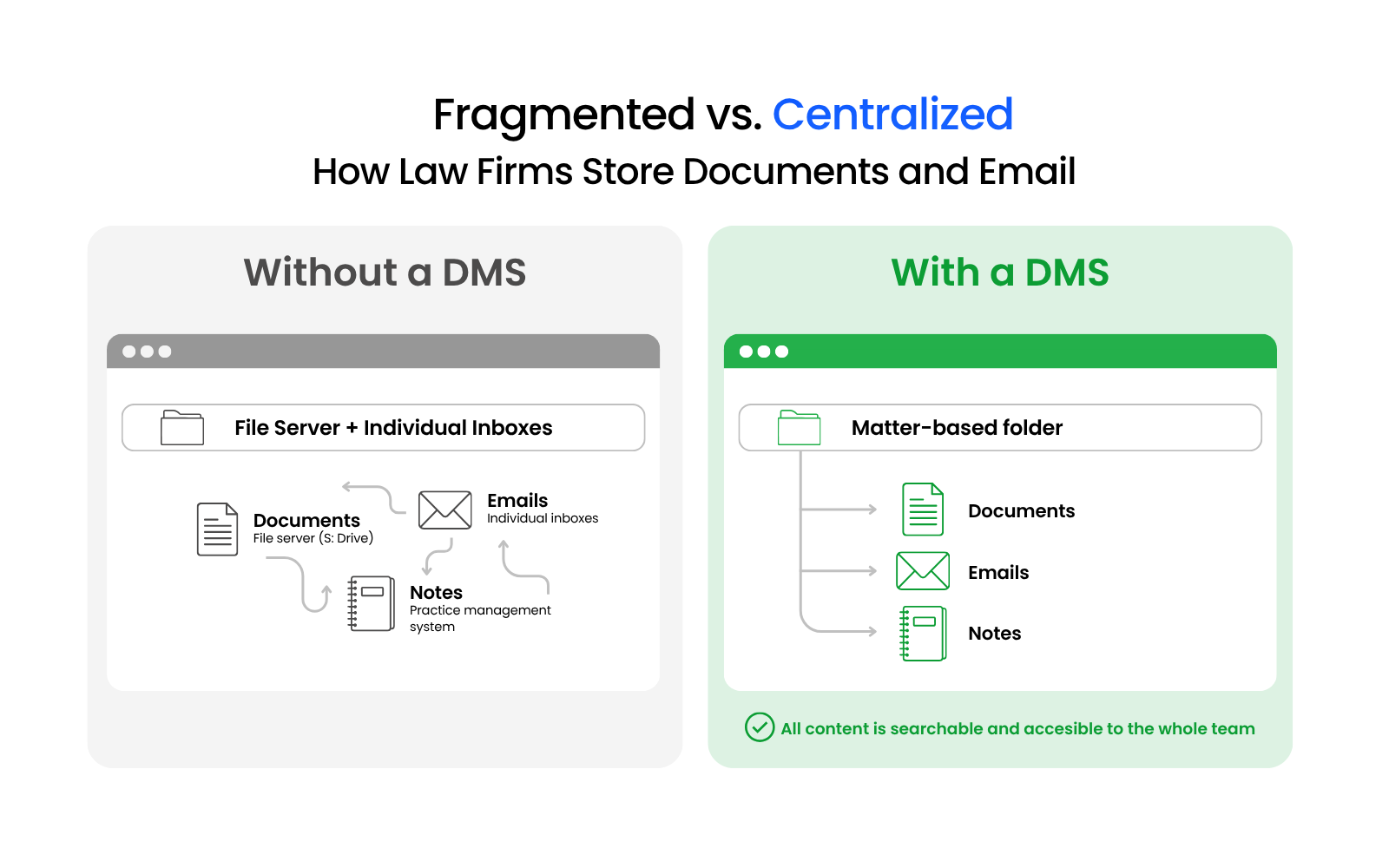
That fragmentation is one of the most common document management mistakes law firms make, and it compounds the longer it goes unaddressed: compliance exposure grows, context loss accumulates, and time spent hunting for information across Outlook, the file server, and the practice management system adds up in ways that never appear on any invoice.
The team-scale issue is particularly acute. Inbox-based document and email management can function for a solo practice. The moment your firm has more than a few people working on shared matters, things start to break down: matter context gets locked in individual inboxes instead of living in a shared, searchable system.
A DMS centralizes that context. Documents, emails, and notes for each matter are organized, searchable, and accessible to your full team, not dependent on one person’s organizational habits. It’s an operational foundation that makes everything from onboarding to client service to attorney transitions less fragile.
Legal Document Management Features
Before evaluating specific products, it helps to know which features are table-stakes, which are advanced, and which have become 2026-era expectations.
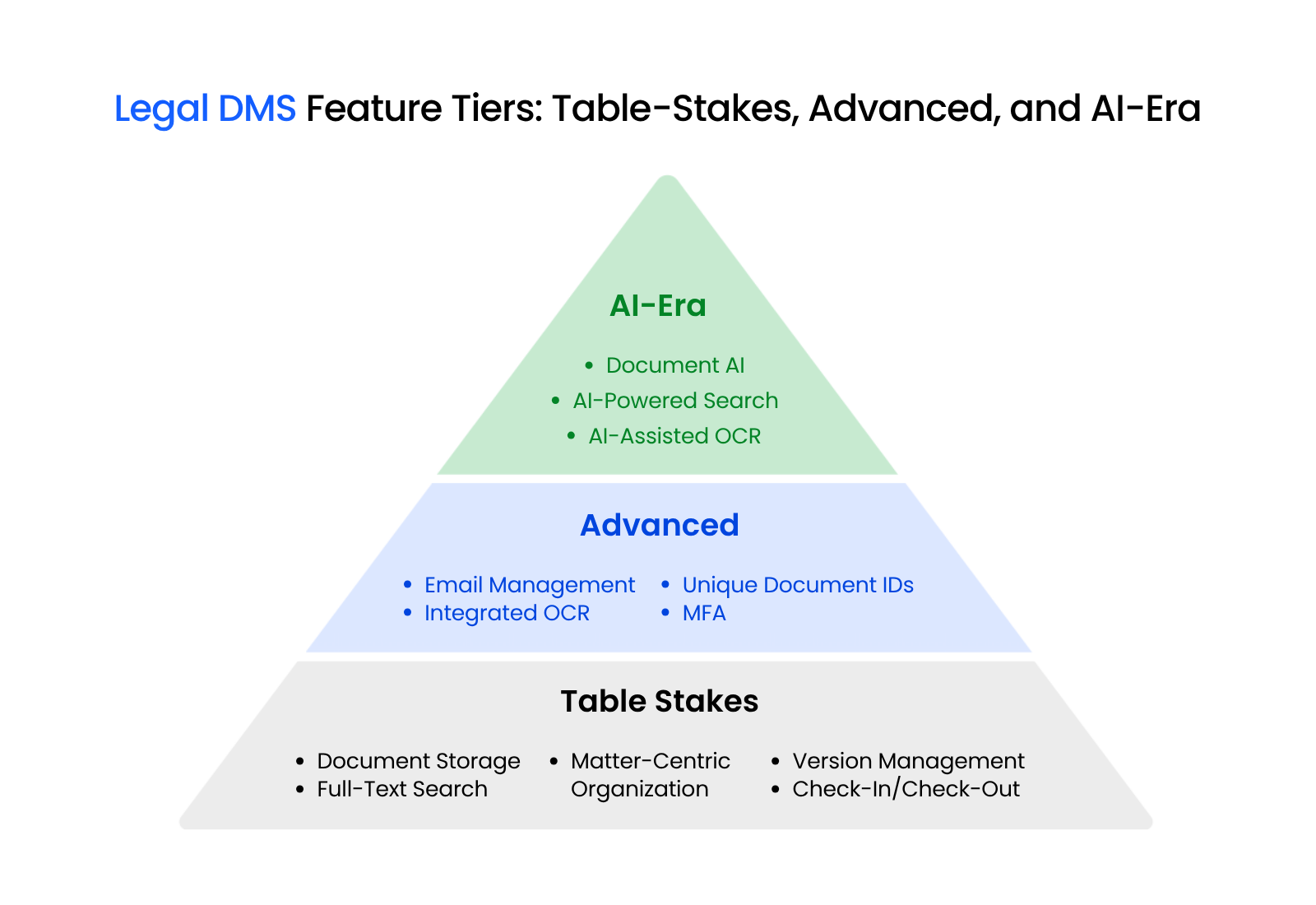
Tier 1 — Table-Stakes Features
Every real DMS should include all of these. If a product you’re evaluating lacks any of them, it’s file storage, not document management.
Tier 2 — Advanced Features
These features separate basic and full-featured DMS platforms. Expect them in dedicated DMS solutions; don’t expect them in practice management document modules.

DMS Benefits for Law Firms
A deeper look at why law firms implement document management systems — and what operational changes follow once they do.
Tier 3 — AI-Era Features
2026-era AI evaluation turns on a distinction most vendors don’t make clearly: whether the AI works on a single document or across the whole matter.
LexWorkplace includes Document AI, Matter AI, and AI-powered search as standard features on all plans, not as an enterprise tier or paid add-on. iManage and NetDocuments both offer platform-wide AI search (Ask iManage, ndMAX’s Smart Answers). Neither publishes which plans include it, which is the question to ask when you evaluate them.
Each of these capabilities gets a deeper look in our DMS feature breakdown.
When Does a Law Firm Need a DMS?
Most firms don’t make a deliberate choice to use the wrong system. They just never upgraded when complexity outgrew what they had. These are the clearest signals it’s time.
What to Look for in a Legal DMS in 2026
Vendor demos all look impressive. The real evaluation happens when you ask specific questions and hold the answers to real criteria. Here are six worth pressure-testing.
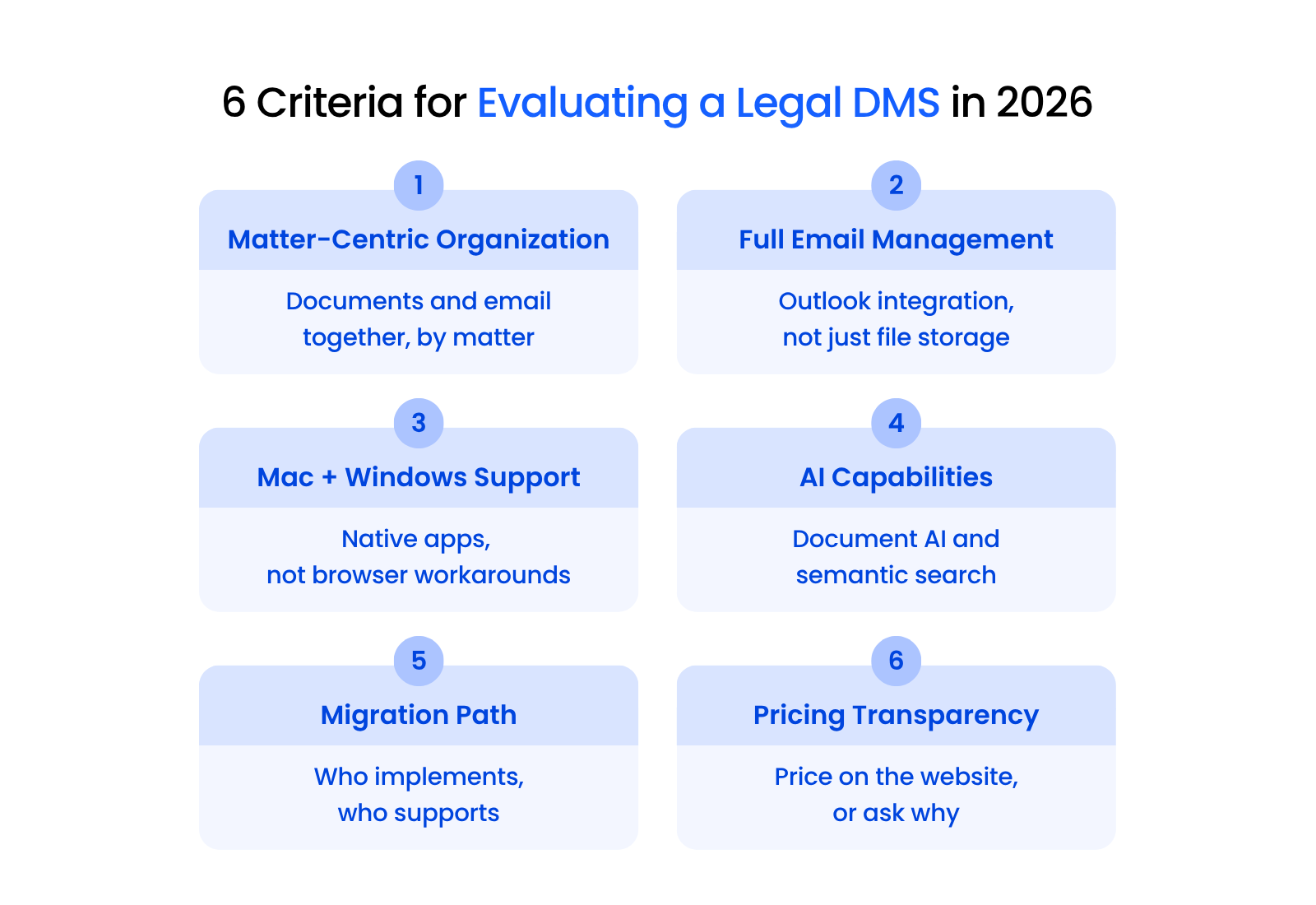
Criterion 1 — True Matter-Centric Organization
A legal DMS should organize work the way your firm actually works: by client and matter, with all related content together.
Documents, emails, notes, and versions for a matter should live in one place, accessible to your team. Not in parallel systems. Not in someone’s inbox. When you’re evaluating a product, ask: does this system organize documents and email together by matter out of the box, or does it require configuration to approximate that?
The answer tells you whether the product was built for legal work or adapted for it. Software built for legal work gets this right by default. Everything else is a workaround.
Criterion 2 — Full Email Management, Not Just Document Storage
Storing documents in a DMS while leaving email in individual Outlook inboxes is solving half the problem. Based on working with hundreds of law firms, good email and document management comes down to four things:
Firms that get all four right operate in a fundamentally different way than firms that only get one or two.
When evaluating a DMS, ask specifically: can I save emails to a matter from within Outlook without switching applications? Can the whole team search email and documents in one place? Our email management for law firms guide covers what good email management looks like in practice.
Criterion 3 — Mac and Windows Support
Many DMS platforms have Windows-native desktop applications, and browser-based or third-party workarounds for Macs, not native applications. That distinction matters every day for attorneys and staff on Mac.
If any attorneys or staff in your firm use Macs, ask this directly: is the desktop application, including the Outlook add-in, available natively on both platforms? Or does Mac support mean browser access? A workaround is a degraded daily experience, and degraded daily experiences drive non-adoption faster than almost anything else.
Criterion 4 — AI Capabilities
Every legal software vendor mentions AI in 2026. That phrase covers a wide range, from real capability to branded feature buttons with limited utility.
Ask specifically: what can your AI actually do? Can it summarize a document in natural language? Can you ask questions about a document’s content? Does AI-powered search work across both documents and email in a single query? Does the AI work on one document at a time, or can it answer questions across everything in the matter, documents, email, and notes together? Is this available on all plans or only an enterprise tier? Document AI, Matter AI, and AI-powered search are real productivity multipliers when they work well, and real sales noise when they don’t.
Criterion 5 — Migration Path and Vendor Accountability
Who implements the software, and what does that relationship look like?
Some platforms, iManage and NetDocuments, require you to purchase and implement through a certified reseller or consultant. You can’t evaluate or buy them directly. That adds cost, complexity, and a third party in the support chain. For a 50-attorney firm with dedicated IT, that’s a manageable structure. For a 10-attorney firm, it changes the entire relationship before you’ve signed anything.
Ask any DMS vendor: who manages the implementation, who do I call when something breaks, and does that relationship go through an intermediary?
Criterion 6 — Pricing Transparency
If the price isn’t on the website, ask yourself why.
Enterprise pricing structures are designed for procurement processes, not direct evaluations. Transparent pricing lets you compare quickly and make an informed decision. Opaque pricing adds a gatekeeping step that serves the vendor’s sales process more than it serves your evaluation. Knowing the price upfront, including what’s included at each tier, is part of evaluating whether a product is actually designed for firms like yours.
These criteria don’t all point to the same product. A 100-attorney firm with dedicated IT has different requirements than a 12-attorney general practice. Use these as filters, not a scorecard, and weight the ones that reflect your firm’s specific constraints.
Why Cloud-Based DMS Is the Right Choice for Most Law Firms
Cloud DMS is the right default for most law firms today, not a premium option, and not a subject that requires much debate for firms under 100 users.
On-premise DMS still exists (iManage supports it, and some enterprise configurations still rely on it), but for most firms, the case for managing your own server infrastructure has narrowed significantly. The operational and security arguments for cloud have gotten stronger over time, and the counterarguments have weakened.
Data Security
The security posture a cloud DMS provides (encryption at rest and in transit, multi-factor authentication, role-based access controls, and geographically redundant backups) is, for most law firms, meaningfully stronger than what you’d achieve managing your own infrastructure.
Cloud providers invest in security at a scale that individual law firm IT environments can’t match: patching schedules, backup integrity, and 24/7 monitoring are all managed for you as part of the service. Under the ABA’s Model Rules, which require firms to make reasonable efforts to protect client data, a cloud DMS with documented security controls gives you a defensible operational posture that a self-managed server can’t easily replicate.
Work Anywhere
Every member of your team gets the same access to the same current documents and emails regardless of where they’re working. That matters not just for remote work, but for ensuring the associate in the second office, the paralegal at the courthouse, and the partner working from home all start from the same state: the same version, the same email thread, the same matter history.
Reduced Risk of Data Loss
The most common trigger for law firm DMS migrations is a server failure with a backup that didn’t work. Sometimes it’s days of work lost. Sometimes it’s more.
Cloud DMS eliminates this failure mode. Your data is replicated automatically across multiple data centers, not sitting on a single drive in your server closet. There’s no backup you need to remember to verify. Our document management vs. cloud storage analysis covers the difference between cloud and on-premise resilience in more depth.
Lower IT Costs and Email Integration
No servers to buy, no maintenance contracts, no emergency calls when hardware fails. The infrastructure is managed for you, and it scales as your firm grows without capital investment in new hardware.
Combined with integrated Outlook email management (save emails to matters directly from Outlook, keep all matter communication searchable alongside documents) cloud DMS gives your firm a single source of truth for matter content without additional infrastructure complexity.
The Right DMS Will Transform How Your Firm Works
The best legal document management software isn’t the one with the most features, it’s the one your firm will actually use consistently.
For most cloud-ready law firms, LexWorkplace gives you the right combination of purpose-built functionality, transparent pricing, and practical onboarding.
If you’re at enterprise scale, iManage and NetDocuments are worth evaluating. If you’re already on Clio or MyCase and your document needs are simple, you may not need a separate DMS yet. But if you’ve outgrown what you have, the upgrade is worth making sooner rather than later.
WHAT’S NEXT