
Table of Contents
SharePoint for law firms often starts as the free answer that comes bundled with Microsoft 365. For a small firm, that might hold up fine. For a firm with real matter volume, it usually falls short fast.
It works fine as basic cloud storage: a place to save files and reach them from anywhere. What it doesn’t do on its own is organize documents by client and matter, track versions automatically, or manage email alongside files – the gap that separates storage from real legal document management software.
Firms usually hit that wall once headcount and matter volume grow past a handful of people. Here’s where SharePoint holds up for a law firm, where it doesn’t, and how to tell which side you’re on.
What Is SharePoint, and How Do Law Firms Use It?
SharePoint is Microsoft’s content management and collaboration platform, bundled into Microsoft 365, and most law firms first encounter it as a place to store files rather than a dedicated legal tool. It’s been around since 2001, long enough to become the default hub that OneDrive, Teams, and Word all connect to inside Microsoft 365. Your firm can create Libraries, SharePoint’s version of folders, organized by client, matter, practice area, or however else makes sense for your work.
What Is Basic Cloud Storage?
Cloud storage splits into two categories: basic cloud storage and document management systems. That document management vs. cloud storage split is what decides whether SharePoint alone is enough for your firm.
Basic cloud storage works like an online filing cabinet, a place to store and reach your files quickly from anywhere. Dropbox, OneDrive, and Google Drive all fall into this category alongside SharePoint.
Basic storage runs out of runway once your matter volume grows. You need version tracking, email management, and file profiling to actually manage documents instead of just storing them.
That’s what a document management system adds, and we’ll get into that later in this article. For now, know that SharePoint sits in the basic cloud storage category, not the DMS one.
SharePoint’s Place in the Microsoft 365 Suite
SharePoint works as the shared hub other Microsoft 365 apps plug into. You can upload documents through OneDrive straight into a SharePoint library, or create new documents from inside SharePoint using Word or Excel. Think of it as the central location your team goes to find and edit firm information.
The Difference Between SharePoint and OneDrive
SharePoint and OneDrive serve different roles inside the same Microsoft 365 plan. SharePoint holds your firm’s shared, central documents, the ones the whole team needs, subject to permissions. OneDrive holds each person’s individual files.
SharePoint includes features OneDrive doesn’t, like a shared assets library and collaborative document editing. OneDrive offers a few things SharePoint doesn’t too, including commenting inside documents.
Benefits of SharePoint for Law Firms
SharePoint gives your firm a shared, cloud-based hub for files, with real Microsoft 365 integration and enough structure to support a small, simple practice. It centralizes files, documents, and firm information in one place, so your team spends less time hunting for things. Used alongside Word, PowerPoint, and OneDrive, it becomes the connective layer for your whole Microsoft 365 stack.
SharePoint Features
SharePoint’s feature set covers the basics well:
SharePoint is genuinely useful. Firms that switch from it to a document management system built specifically for law firms, like LexWorkplace, wonder what took them so long. Tools built for your industry work better for your industry.
SharePoint Pricing
SharePoint pricing changed significantly in 2026. Microsoft retired standalone SharePoint plans, Plan 1 and Plan 2, previously $5 and $10 per user per month, as of May 31, 2026. New customers can no longer buy SharePoint on its own; it’s bundled exclusively into Microsoft 365 now.
Microsoft 365 plans that include SharePoint range from Business Basic at $6 to $7 per user per month (after a July 1, 2026 price increase) up to $57 for E5 and $99 for the newer E7 Frontier Suite, depending on what else your firm needs from the bundle.
SharePoint vs. On-Premise File Servers
Some firms still run on-premise file servers instead of the cloud. SharePoint eliminates the need for that hardware: your files live and get accessed entirely through the cloud.
Cloud-based tools like SharePoint:
On-premise file servers work differently:
If you’re starting a new firm, build on the cloud from day one. If you’re still trying to scale a law firm on an S drive, moving to a cloud-based platform is worth the switch.
How to Setup SharePoint for Your Law Firm
Have you decided to go with Microsoft 365 and SharePoint? If so, the initial setup is critical to setting your team up for success. As with any Microsoft tool or app, you’ll want to start by setting up Microsoft 365 first. Then, you can move forward with SharePoint setup.
SharePoint can serve as your law firm’s main file and document storage solution. This means that if you’re transitioning from an on-premise server, SharePoint will effectively replace your old “S:\\ Drive,” or whatever network drive or share previously served as your central storage.
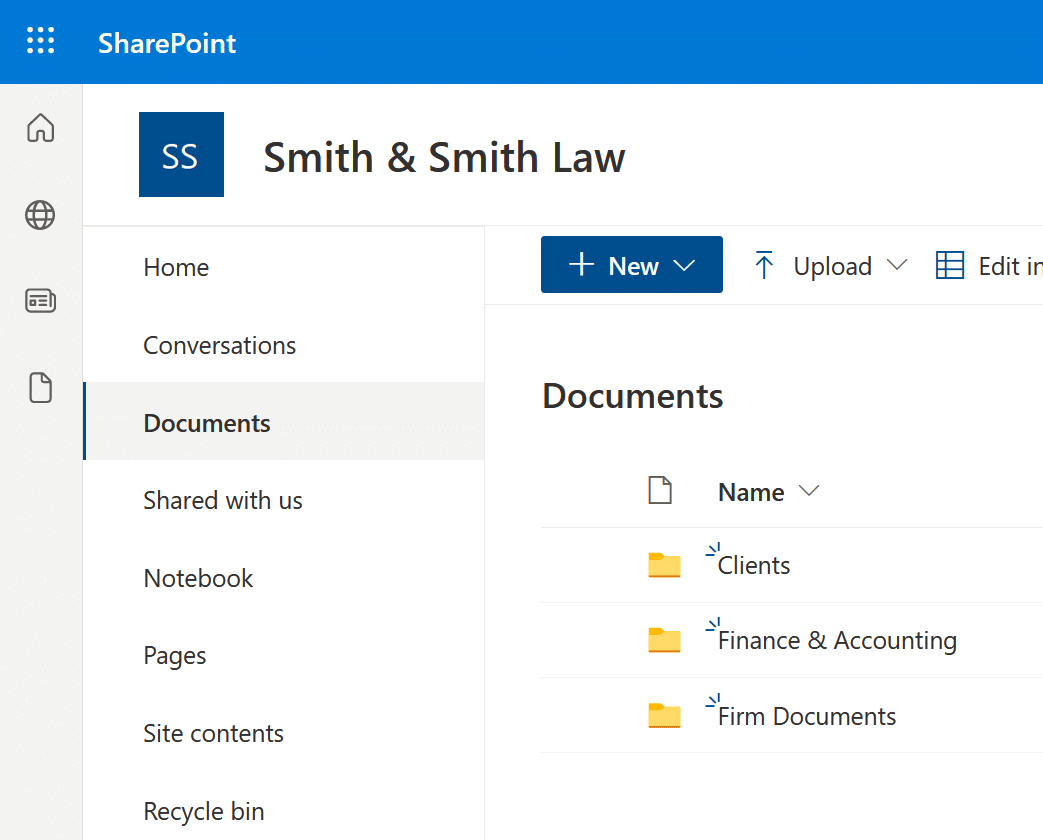
Just like your computer, SharePoint allows you to set up specific folders, depending on your needs. For example, you can create top-level folders (Libraries) that are the main navigation inside SharePoint. Then, you can drill down even further by creating more folders for your firm.
Structuring Your SharePoint
Once you get signed in, it’s time to structure your SharePoint to prepare for use. We recommend structuring your top-level folders (Libraries) like this:
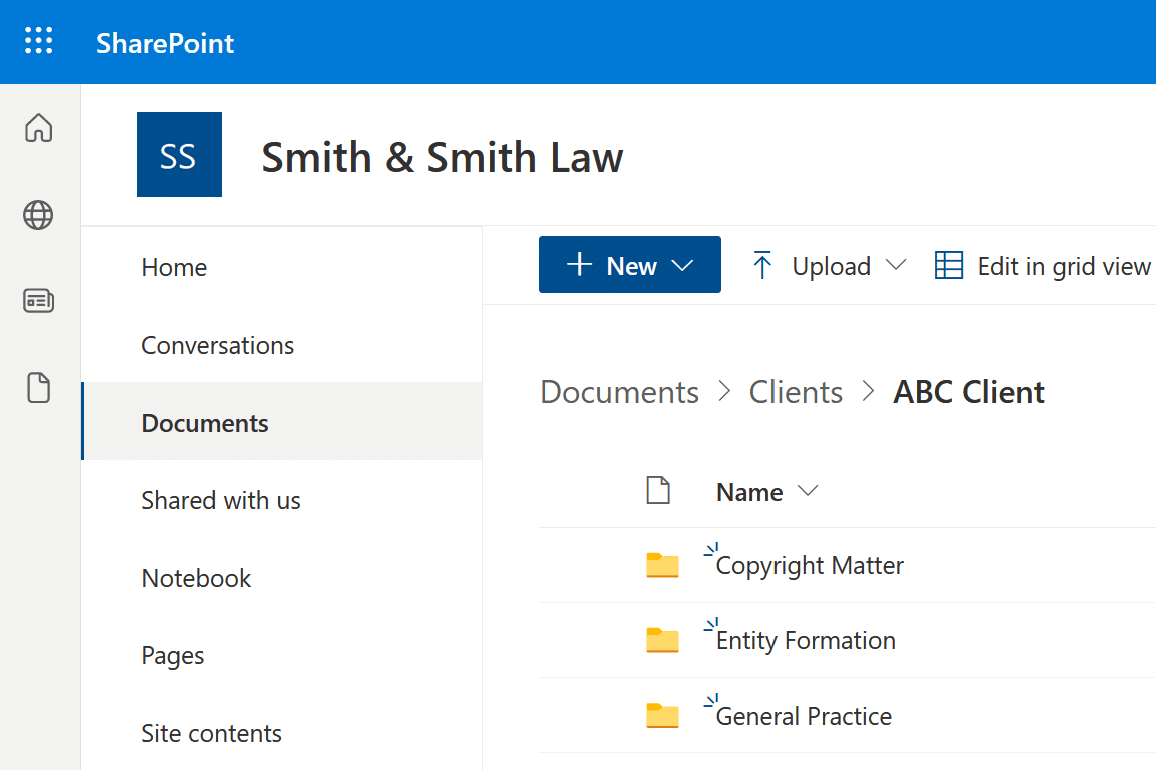
For many clients, we recommend one folder per client, then a subfolder for each discreet matter or project for that client. If a client has both defined matters and general ongoing work, you can create a general-purpose matter folder for that client called General Practice or something similar.
During the initial setup of Microsoft 365, you’ll be able to create Groups. We recommend doing this, so you can create SharePoint Libraries within each group for who needs access to what.
To access your SharePoint, you and your team can use the SharePoint interface or OneDrive, or you can access SharePoint via the Teams client. Since a lot of your work will probably be done inside OneDrive or Teams, we recommend accessing SharePoint in the tool where you’ll be working.
SharePoint’s filing system is a pretty viable option when you’re comparing it to other basic cloud storage like Google Drive, Dropbox, and more.
You can definitely take the time to establish and train your law firm on how to organize the files, so everyone maintains your preferred client/matter structure. Initial and ongoing mistakes can get pretty messy pretty quickly.
If you want more structure without leaving SharePoint entirely, third-party matter-management add-ons can layer client and matter organization on top of your existing setup. That’s a real middle option worth knowing about before you decide to build everything manually or switch platforms.
For that reason, consider a document management system that’s built with a law firm’s preferred structure in mind.
6 Additional Tips for Using SharePoint Within Your Law Firm
SharePoint is already easy to use for law firms that require a centralized location for all files and content. But there are some expert tips you can use to make the most of the tool. Here are a few:
Where Does SharePoint Fall Short for Law Firms?
SharePoint falls short for law firms in five specific ways: it isn’t a true document management system, it gets harder to manage past a handful of people, it has no built-in way to file email to a client or matter, it takes real setup time to match how firms actually organize work, and Microsoft itself suggests bringing in a partner to deploy it. SharePoint is a solid product; it’s just not built for how a law firm actually organizes matter work.
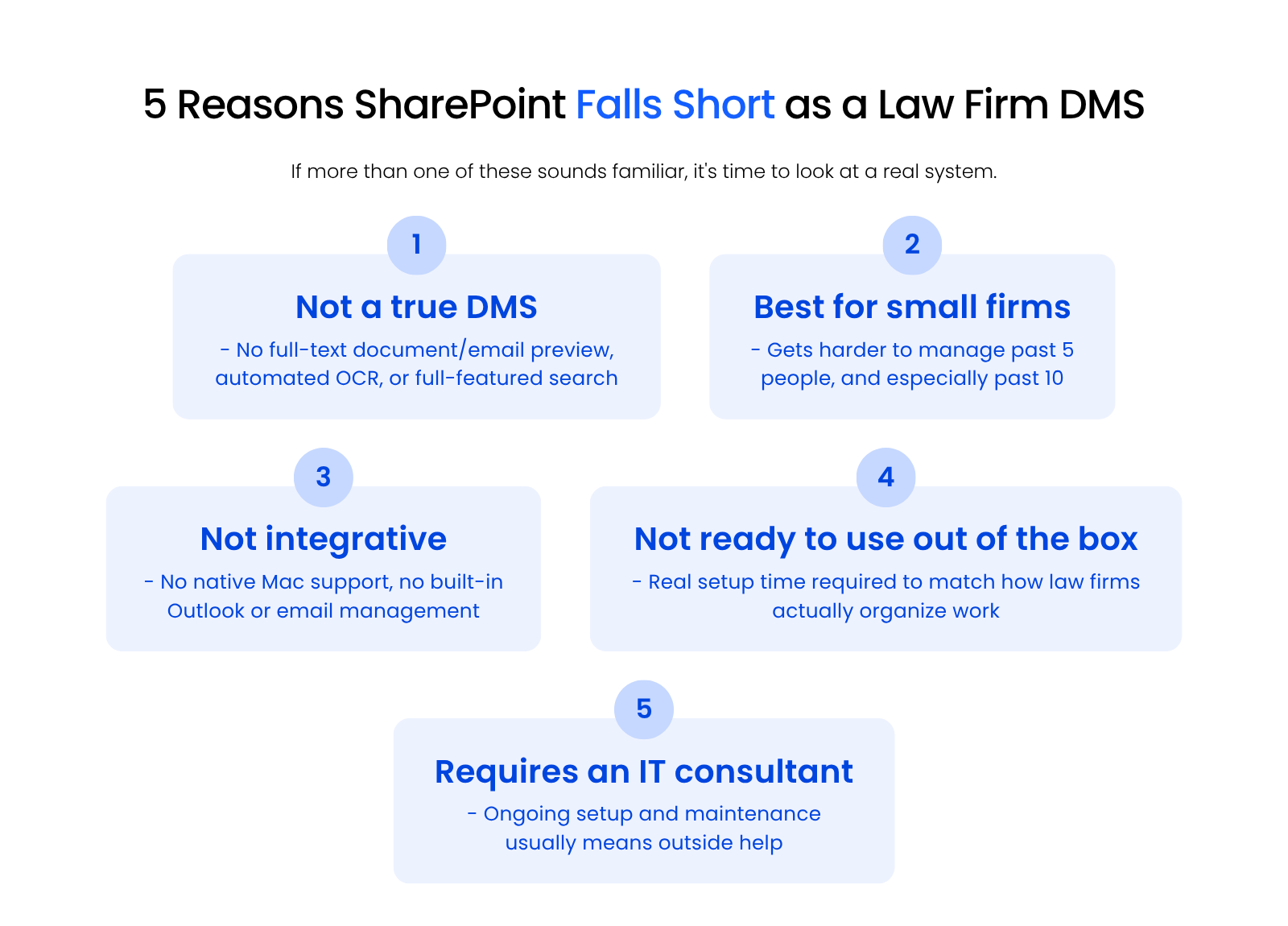
Here’s how those five points play out one by one:
That dependency isn’t accidental.
Generalist IT providers recommend what they already know, across every client they support, whether that’s a law firm, a dental office, or a machine shop. A document management system built specifically for law firms removes that dependency instead of leaving you to manage around it.
SharePoint Reviews and User Feedback
Real SharePoint users have plenty to say, and the reviews span the full range.
| Reviewer | Rating | Takeaway |
|---|---|---|
| Zeynep C., Assistant Lawyer | 3/5 | Extensive features and smooth Office 365 integration, but pricier than it looks once you add the hidden costs, with a real learning curve. |
| Verified user, Legal Services | 2.5/5 | Works well with a strong architecture and governance plan in place; without one, retention and version control become real problems. |
| Verified user, Legal Services | 4/5 | Easy to centrally store and access documents firm-wide, though user-group permissions and department-specific access take real effort to set up. |
| Verified user, Legal Services (g2.com) | 1/5 | Found it hard to use, especially for spreadsheets, and eventually moved that work to Excel instead. |
The pattern in these reviews lines up with the challenges above. SharePoint works, but the friction shows up fastest around permissions, retention, and anything beyond basic file storage.
Is SharePoint the Right Choice for My Law Firm?
SharePoint is the right choice for solo attorneys and very small practices, and the wrong choice once your firm needs matter-centric organization instead of folders.
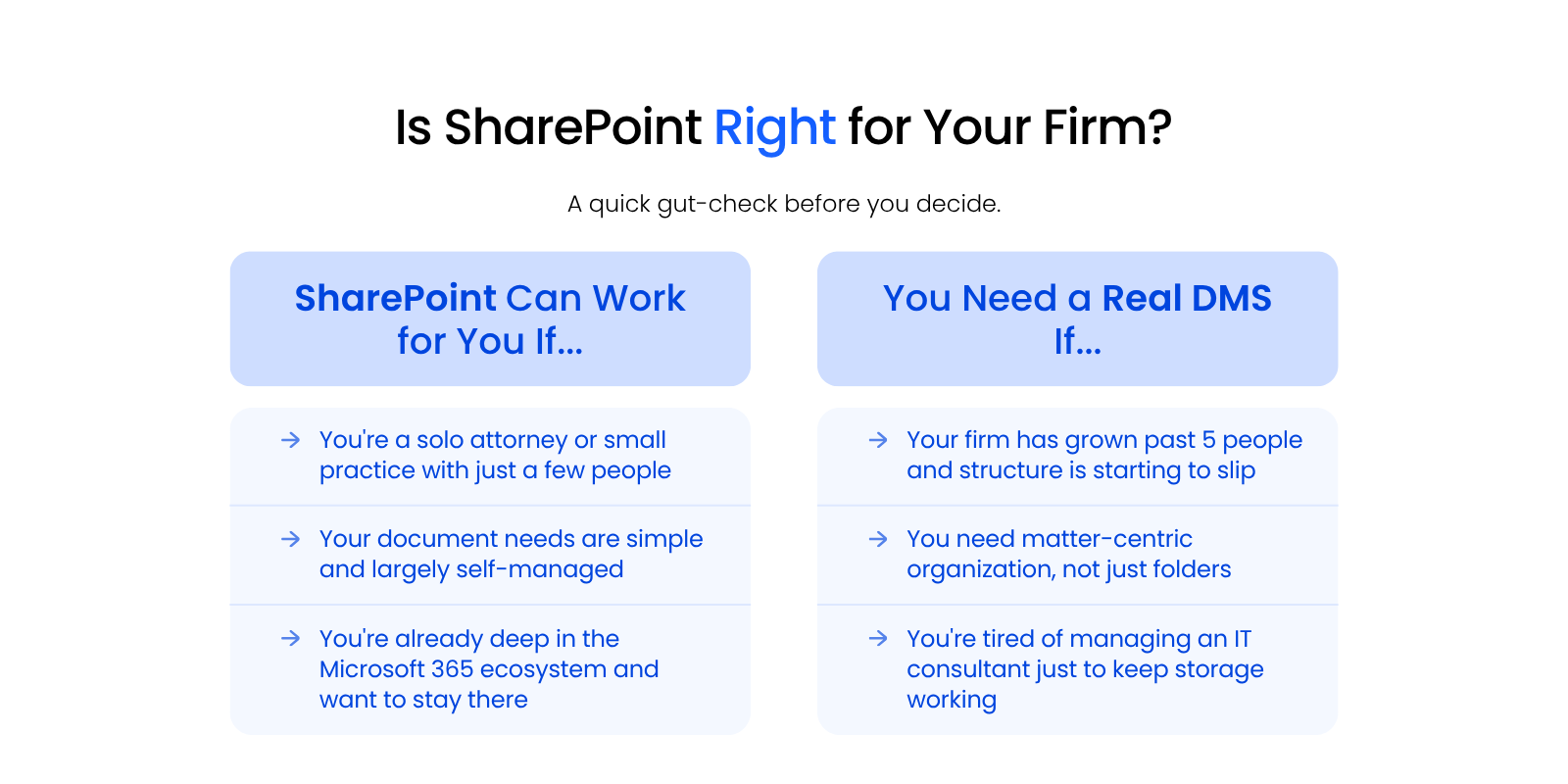
If you’re a solo attorney or a small practice with only a handful of people, SharePoint’s simple cloud storage is genuinely enough. You don’t have the matter volume yet to feel its limits.
Midsize and large firms with five or more people usually need more. Once your team and your document footprint grow, matter-centric organization stops being a nice-to-have and starts being the thing that keeps work moving. Past five people, SharePoint’s cracks start to show. Firms shouldn’t delay a DMS migration much past that point.

What Is a Document Management System?
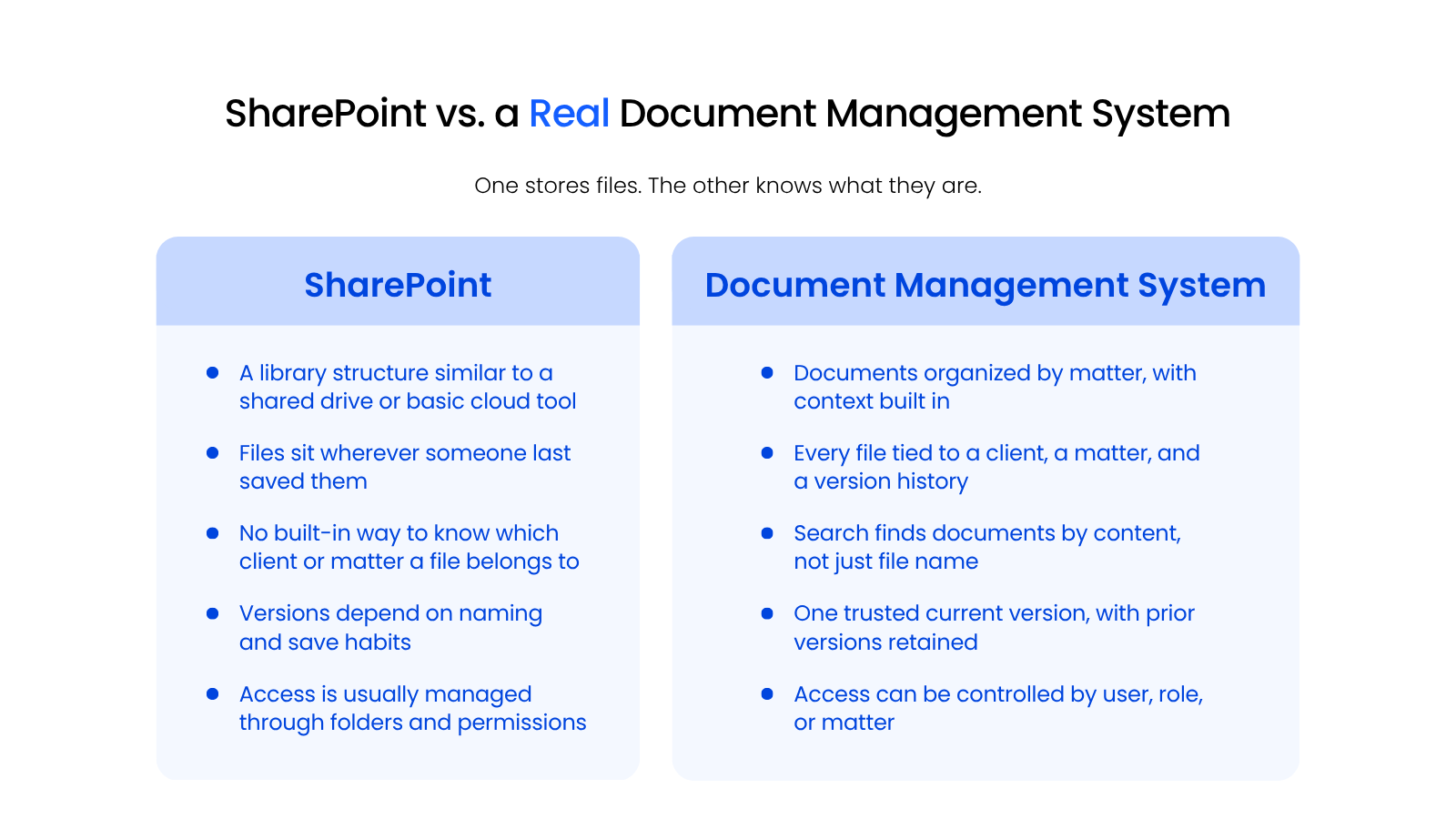
A document management system organizes every file around the client and matter it belongs to, instead of leaving that structure up to whoever saved it last.
Two main types of file storage exist: basic cloud storage and document management systems. Tools like SharePoint, Dropbox, and Google Drive handle basic storage well.
They lack the features many firms need to actually manage documents, not just hold them. A DMS adds strong file storage plus file indexing, document alerts, version management, email management, and tagging on top.
Benefits of Using a Document Management System
Features Included in a Document Management System
A modern legal DMS bundles:
That last one is newer, and it’s quickly become one of the bigger differentiators between a modern DMS and basic storage.
Document AI works like a ChatGPT-style conversation about your documents, so you could ask something like “According to this contract, when did the client first raise the issue?” and get a direct answer, with the usual caveats about double-checking anything that matters. Smart Search and Rights Management round out the newer capabilities worth knowing about: smarter, AI-assisted search beyond keyword matching, and granular permission groups that go well past SharePoint’s basic access controls.
You can see exactly how these stack up against SharePoint in a full feature-by-feature comparison.

Legal DMS Features
A closer look at exactly which features separate a real legal document management system from basic file storage.
Cost of a DMS Solution
A DMS costs more than basic storage, and that difference is what you’re actually paying for. LexWorkplace, for example, starts at Core: $395 per month for 3 users and 1,000GB of storage. The Advanced tier runs $595 per month and adds Integrated OCR and Litera Compare on top. Firms already on Uptime Manage or Cloud services get the Starter tier free.
The benefit outweighs the investment for most firms. Your team works faster, you trust your file storage, and the system scales with you as you grow.
Growth Is What Breaks SharePoint for Law Firms
SharePoint works fine for basic storage, and it’s a reasonable place to start for a solo attorney or a very small practice. Growth changes that.
Once your firm passes a handful of people, matter-centric structure stops being optional and becomes the thing that keeps client work moving. Firms that build that structure early spend a lot less time untangling naming conventions and duplicate versions than the ones who wait until the mess is already there.
WHAT’S NEXT