Table of Contents
Ask a partner to pull up everything the firm has on a matter from two years ago. Every document and every email, right now, while you watch.
What usually happens is a trip to the shared drive for the documents, a switch to Outlook for the correspondence, then a call to a paralegal about the signed version. Then comes the admission that the good copy is on someone’s desktop.
The firm has all of it. It just can’t produce it.
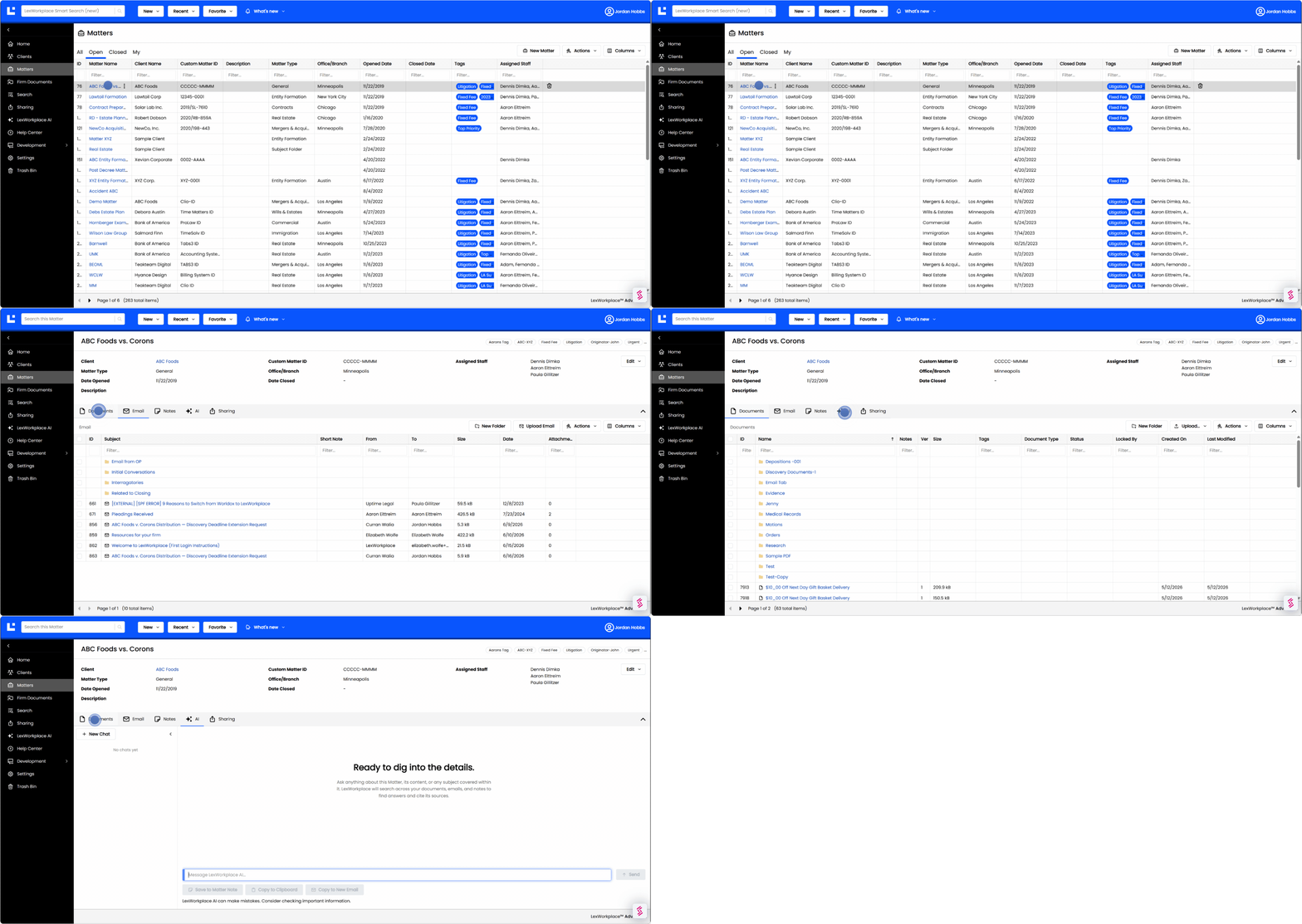
That gap is what matter-centric document management closes. A matter-centric system organizes every file, email and note around the client and matter it belongs to, rather than around whoever saved it last and where they happened to put it. The difference is between a structure the firm has to maintain and one the software enforces.
This guide covers how matter-centric filing differs from folders and how to build it: matter numbering, naming conventions, the client-level and matter-level split, email filing, and why a shared drive can’t hold it.
What Is Matter-Centric Document Management?
Matter-centric document management is a way of organizing a law firm’s files that makes the matter the organizing unit. Every document, email, note and attachment is filed against the client and matter it belongs to. Retrieval works by asking the system for a matter and getting its complete record back, rather than by remembering where someone chose to save something.
The distinction is easiest to see with a single file.
Take a signed engagement letter. In a folder-based system, that letter lands wherever the person who received it decided to put it.
Maybe Clients / Harrow / 2024 / Contracts. Maybe Admin / Engagement Letters. Maybe both, in two slightly different versions.
Finding it later depends on reconstructing that person’s reasoning, and if they’ve left the firm, that reasoning left with them.
In a matter-centric system, the same letter is filed to the matter. It carries its client and matter in its own record, so its file path stops mattering.
Anyone who opens the matter sees it. Nobody has to guess.
The practical consequence is that the structure stops being something the firm has to remember and starts being something the system applies. That’s what legal matter management comes down to in a document system, and everything below is how it gets built.
What This Is Not
Matter-centric document management handles the firm’s documents and email, and leaves the calendar, billing, docket and time entries to other systems.
Those belong to practice management software, which is a different category solving a different problem. Plenty of firms run both, and the two integrate. But a practice management tool with a document tab isn’t a document management system, and treating it as one is how firms end up with the matter’s correspondence in one place and its work product in another.
If your firm is still deciding which of the two it needs first, the breakdown of how practice management and document management differ covers that question directly.
What Changes When Filing Is Matter-Centric
The benefits of matter management software come from the matter, rather than the folder, holding the record; owning the software alone doesn’t produce them.
Any Attorney Can Reconstruct a Matter without Asking Who Worked on It
The complete history of a matter sits in one place: documents, correspondence, notes, attachments. A partner picking up a colleague’s file doesn’t need a handoff conversation to find out where things are. The record is the record regardless of who built it.
This is the benefit that matters most during coverage, turnover and anything urgent, which is exactly when the firm has the least time to go looking.
A New Associate Is Productive Immediately
Every matter looks the same. There’s one structure, applied everywhere, so learning it once is learning it for the whole firm.
Compare that to a folder system, where a new hire has to learn the conventions of each practice group, each partner, and in some firms each paralegal, because nothing forced those conventions to agree with each other in the first place.
Closing or Transferring a Matter Is a Defined Action
When the matter is the container, closing it is a single operation. Everything associated with the matter is already associated with the matter.
In a folder system, closing a file means hunting for its pieces: documents in one place, email in individual inboxes, the executed copies wherever they landed. Transferring a matter to new counsel has the same problem, with a deadline attached.
Conflict Checks and File Requests Stop Depending on Memory
A client asks for their file. Opposing counsel references a letter from eight months ago. A conflict check needs every matter touching a given party.
Each of those is a search problem, and searching works when the thing being searched is structured consistently. When it isn’t, your firm falls back on the person most likely to remember, which isn’t a system.
What a Document Management System Actually Is
The term “document management” gets used loosely, and a lot of what gets called a document management system (DMS) isn’t one.
A legal document management system is a platform, cloud-based or on-premise, that does more than store a firm’s documents. It gives the firm the tools to find, categorize, version and control them, with the client and matter structure built in rather than improvised.
Here’s what doesn’t qualify:
The line is whether the system understands what a matter is. If the answer is no, your firm is providing that understanding manually, forever.
Why a Firm Needs One
The practical case for one comes down to five things.
All five depend on the system knowing which matter every file belongs to, and the features below are how it knows.
Matter Management Software Features to Evaluate
Product feature lists tend to read as nouns. What matters is what each one does for a matter.
Cloud-based systems typically add:
Each of these is covered in more depth in a fuller breakdown of DMS features.

How to Structure Matter-Centric Filing
A matter-centric structure needs two decisions made once and applied everywhere: how matters are numbered, and how documents are named inside them. Every other matter management best practice follows from those two.
Matter Numbering
The job of a matter number is to identify a matter permanently and unambiguously, and nothing more; it should never try to double as a filing system.
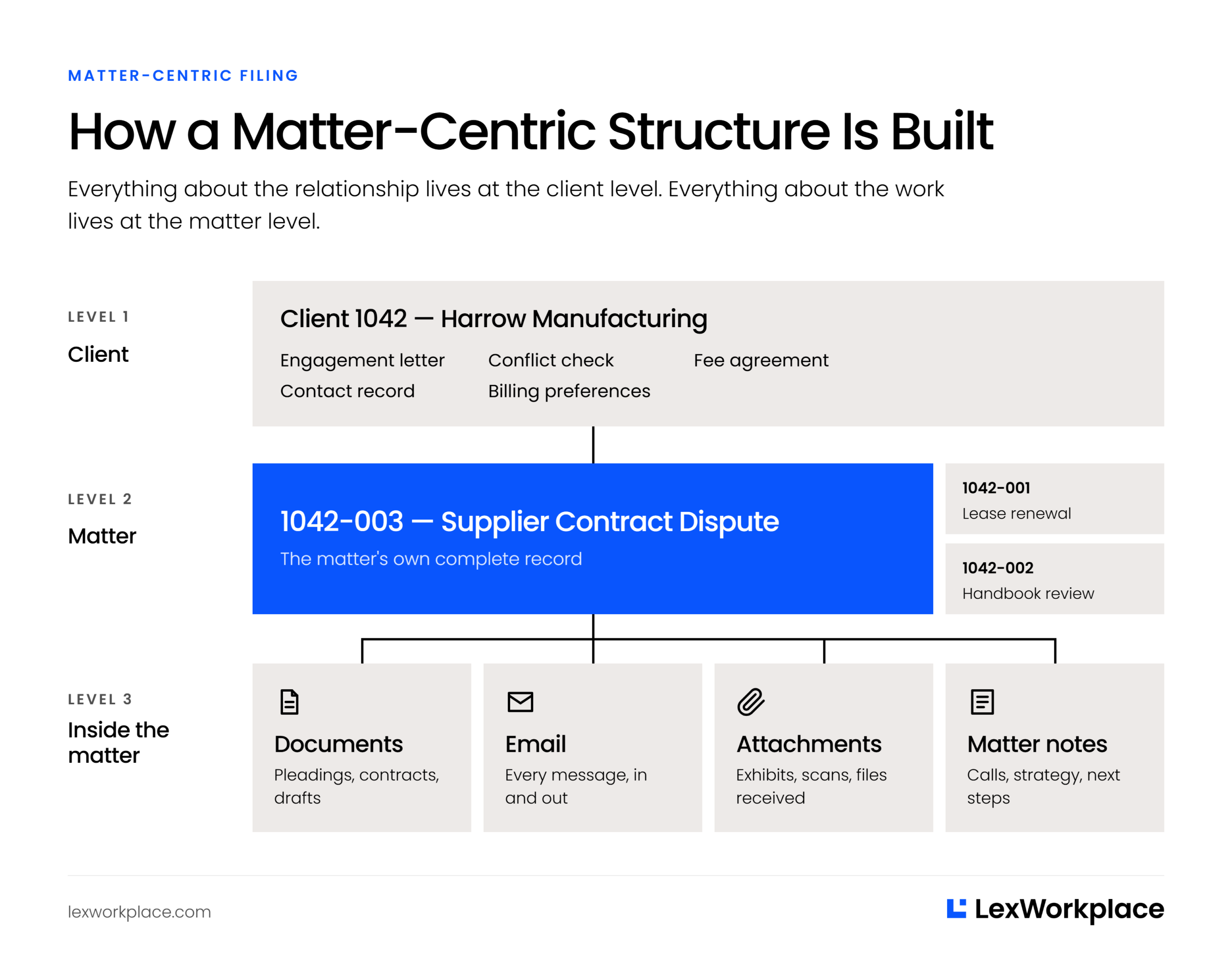
A workable pattern is a client number plus a matter sequence:
1042-001   Harrow Manufacturing: Supplier Agreement Review
1042-002   Harrow Manufacturing: Employment Policy Update
1042-003   Harrow Manufacturing: Supplier Contract Dispute
1187-001   Calder Estate: Probate Administration
Three rules make this hold up.
Number sequentially. The temptation is to encode meaning: LIT-2024-HARROW-03. It reads well on day one and badly on day four hundred, because descriptive numbers invite disagreement about which description is right, and two people will encode the same matter differently.
Never encode anything that can change. Practice area, responsible attorney, status and year all move.
A matter that starts as a contract review and becomes litigation doesn’t get renumbered, and a matter whose responsible attorney leaves doesn’t either. If the number contains that information, it’s now wrong, and nobody will fix it.
Assign the number at intake, before anything is filed. A matter that gets its number after documents start arriving has documents that predate the structure, and those are exactly the ones that go missing.
Naming Conventions
Inside the matter, names exist to make a list of files scannable. A consistent pattern does that; a descriptive one doesn’t.
2026-03-14_Agreement_Supplier-Master-Services.pdf
2026-03-21_Correspondence_Opposing-Counsel-Response.pdf
2026-04-02_Pleading_Motion-to-Compel.docx
The pattern is date, then document type, then a short descriptor.
Date first, in ISO format. 2026-03-14 sorts correctly by default. 3-14-26 doesn’t, and “March 14” sorts alphabetically into nonsense.
Document type second. This is what makes a long matter scannable. Filtering a hundred-file matter down to pleadings is a matter of reading one column.
Descriptor last, and short. The descriptor only needs to distinguish this file from its neighbors, so keep it well short of a summary.
Leave versions out of the filename entirely. _v2, _FINAL, _FINAL-revised and _FINAL-USE-THIS are what a firm writes when the system isn’t tracking versions. A DMS with version management makes all of it unnecessary, and continuing the habit inside one actively hides which version is current.
Why This Is Decided Once
The numbering and naming scheme is the part of the structure that outlives the people who set it up. It’s also the part that’s expensive to change, because changing it means revisiting everything already filed.
Firms that invent structure as they go end up with a structure only its authors understand. That works until it doesn’t, and it stops working at exactly the moment a key person leaves.
What Belongs at Matter Level vs. Client Level
The distinction firms get wrong most often is which records belong to the client and which belong to the work.
The rule is simple: anything true of the relationship lives at the client level, and anything true of the work lives at the matter level.
The edge case worth deciding now: a fee agreement amended for a single matter. The original stays at client level, because it still governs everything else.
The amendment lives at matter level, because it’s true only of that matter. Filing the amendment at client level makes it look like it applies to all of them, which is the kind of error that surfaces during a fee dispute.
Decide this once, write it down, and apply it. The cost of leaving it to judgment is that two people will make opposite calls and both will be defensible.
Getting Email into the Matter
The correspondence is half the matter, and it’s the half most likely never to make it into the system at all. Most of a matter’s story is told in email, because that’s where attorneys work.
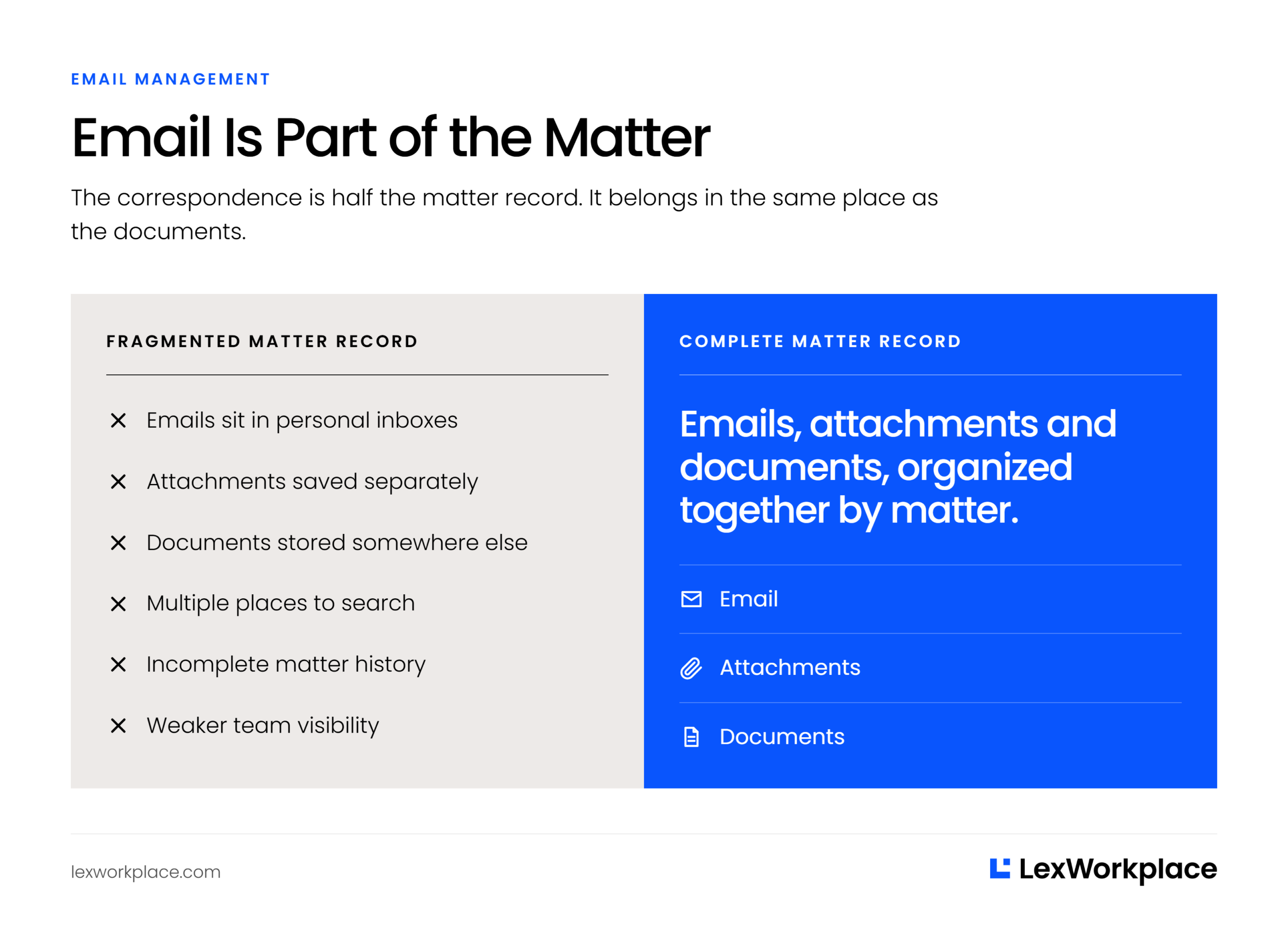
A matter whose documents are perfectly structured and whose email lives in four separate Outlook accounts is only a well-organized fraction of a complete record. When an attorney leaves, their inbox leaves, and with it the negotiation history, the client’s instructions and the reasoning behind decisions nobody wrote down anywhere else.
File from Outlook. If saving an email to a matter requires saving it to the desktop and uploading it, it won’t happen consistently.
The filing has to be a click inside the email client where attorneys already are, or it becomes a task that competes with billable work and loses. The mechanics are covered in the guide to Outlook email filing.
Decide what happens to attachments. An attachment filed only as part of its email is hard to find later; a document filed with no link to the message that transmitted it loses its context. The system should keep both, and your firm should know which one it’s relying on.
“I’ll file it later” is where the structure fails. Email filing is the only part of matter-centric practice that depends on daily behavior rather than one-time setup.
Everything else can be decided once. This has to be done every day by everyone, which is why it’s the part that needs the lowest possible friction.
This is also the clearest case for why email and document management belong together.
Why This Breaks on a Shared Drive
A shared drive can be given matter-shaped folder names. Nothing stops a firm from creating Clients / 1042 Harrow / 003 Supplier Dispute and filing diligently inside it.
What a shared drive can’t do is enforce any of it, index across it, or prevent the next person from doing it differently.
It stops working at scale. Folders that felt tidy at ten matters become unusable at a hundred. There’s no matter-centric spine holding the structure together, so consistency is convention, and convention doesn’t survive contact with volume.
It leaves when its designer leaves. The structure exists in one person’s head. A folder tree records the decisions but not the reasoning, so the next person inherits a system they can follow but not extend, and the first ambiguous case starts a second convention alongside the first.
It loses the firm’s trust, and then everyone hedges. The specific failure looks like this: people stop believing the shared drive holds the current version, so they keep private copies.
Once private copies exist, there’s no single source of truth, and the firm is now maintaining an unknown number of parallel records with no way to tell which is authoritative. The cost is concrete: a document produced from the wrong copy, or an hour spent reconciling three versions before a filing.
It can’t search what it can’t read. Scanned PDFs without OCR are stored but not findable. A firm with a meaningful volume of scans has documents it technically possesses and functionally can’t retrieve.
None of this arrives as a single failure; it accumulates, and it surfaces on the day the firm has the least room to absorb it. Most firms see the signs they have outgrown shared drives well before that day comes.
Where to Start
The first move in a DMS implementation is the numbering scheme, well before any migration.
Deciding how matters will be numbered and how documents will be named costs an afternoon. Migrating into a structure that hasn’t been decided costs that afternoon plus the migration, plus a second migration later when the scheme changes.
A workable order:
- 1
Decide the matter numbering scheme. Client number plus matter sequence. Sequential, with nothing encoded that can change.
- 2
Decide the naming convention. Date, type, descriptor. Versions handled by the system.
- 3
Decide the client-level and matter-level split, including the edge cases, and write it down.
- 4
Then look at what the firm currently has, and what moving it would involve.
Firms that do the fourth step first end up doing all four twice.
WHAT’S NEXT
Frequently Asked Questions
Short answers to the questions firms ask most when they set this up.