Table of Contents

If your firm is comparing iManage and NetDocuments, you’re looking at the two biggest names in legal document management. Both are powerful. Both have been around for decades. And both may be more system than your firm actually needs.

The hard part is deciding which one fits how your firm actually works — and whether a more modern option belongs in the conversation. The right DMS depends on your firm’s size, your IT resources, and how much overhead you’re willing to carry.

This comparison breaks down where iManage and NetDocuments differ, who each one is built for, and how they stack up against the best legal document management software available today.

Table of Contents

Here’s how iManage, NetDocuments, and LexWorkplace compare across the factors that matter most when your firm is choosing a document management system.

A table comparing iManage, NetDocuments, and LexWorkplace.

How to Choose Between iManage and NetDocuments

The choice between iManage and NetDocuments comes down to five practical questions: where the system runs, how much IT it demands, whether it supports Mac, how it handles security, and what it really costs to own. These are the areas where the two products — and the modern alternatives to both — actually diverge.
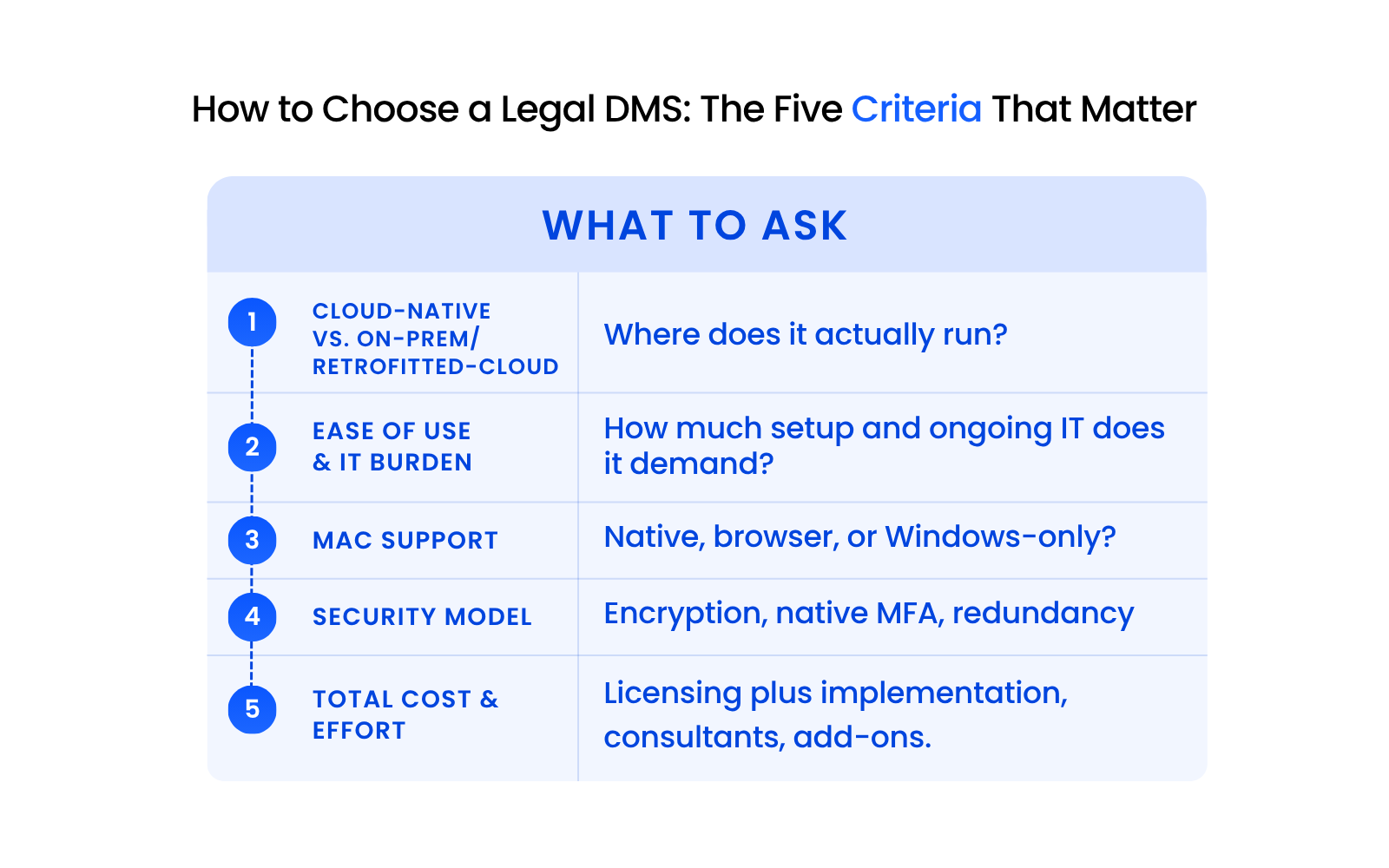
Most feature charts treat every row as equal, when only a few criteria actually drive the decision for most firms:

  • Cloud-native vs. retrofitted cloud. Some systems were built for the cloud from the start. Others started on-premise and added a hosted option later. The difference shows up in how the product feels to use and how much infrastructure sits behind it.

  • Ease of use and IT burden. This is where legacy and modern tools split hardest. A heavier system can demand mandatory document profiling — answering several required fields before you can save anything, whether it’s a critical brief or a quick note. A ten-second save becomes thirty, hundreds of times a day. That overhead is a big reason smaller firms walk away from traditional DMS platforms after a demo.

  • Mac support. If any of your attorneys work on a Mac, how a system handles that matters. Native support, browser-only access, and Windows-first design are not the same experience.

  • Security model. Look at encryption, multi-factor authentication, and data redundancy — and whether each is built in or bolted on through add-ons.

  • Total cost and effort. The license is rarely the whole bill. Implementation, consultants, and add-on modules often cost more than the software itself.

What Law Firms Miss

The biggest difference between a legacy DMS and a modern one isn’t features — it’s IT burden. Mandatory profiling and per-machine setup turn small daily tasks into friction that adds up fast.

A real DMS does more than store files the way document management vs. consumer-grade cloud storage makes clear: it runs OCR, tags and profiles documents, and searches full text across everything your firm has — organized around clients and matters, with structure built into the tool rather than left to whoever follows the file-naming policy that day.

Keep these five criteria in mind as you read the breakdowns below.

The Verdict: Which Should Your Firm Choose?

For most firms, the choice breaks down by size and IT capacity: iManage suits large firms with dedicated IT, NetDocuments suits mid-to-large cloud-first firms, and LexWorkplace suits small-to-midsize firms that want a modern system without the overhead.
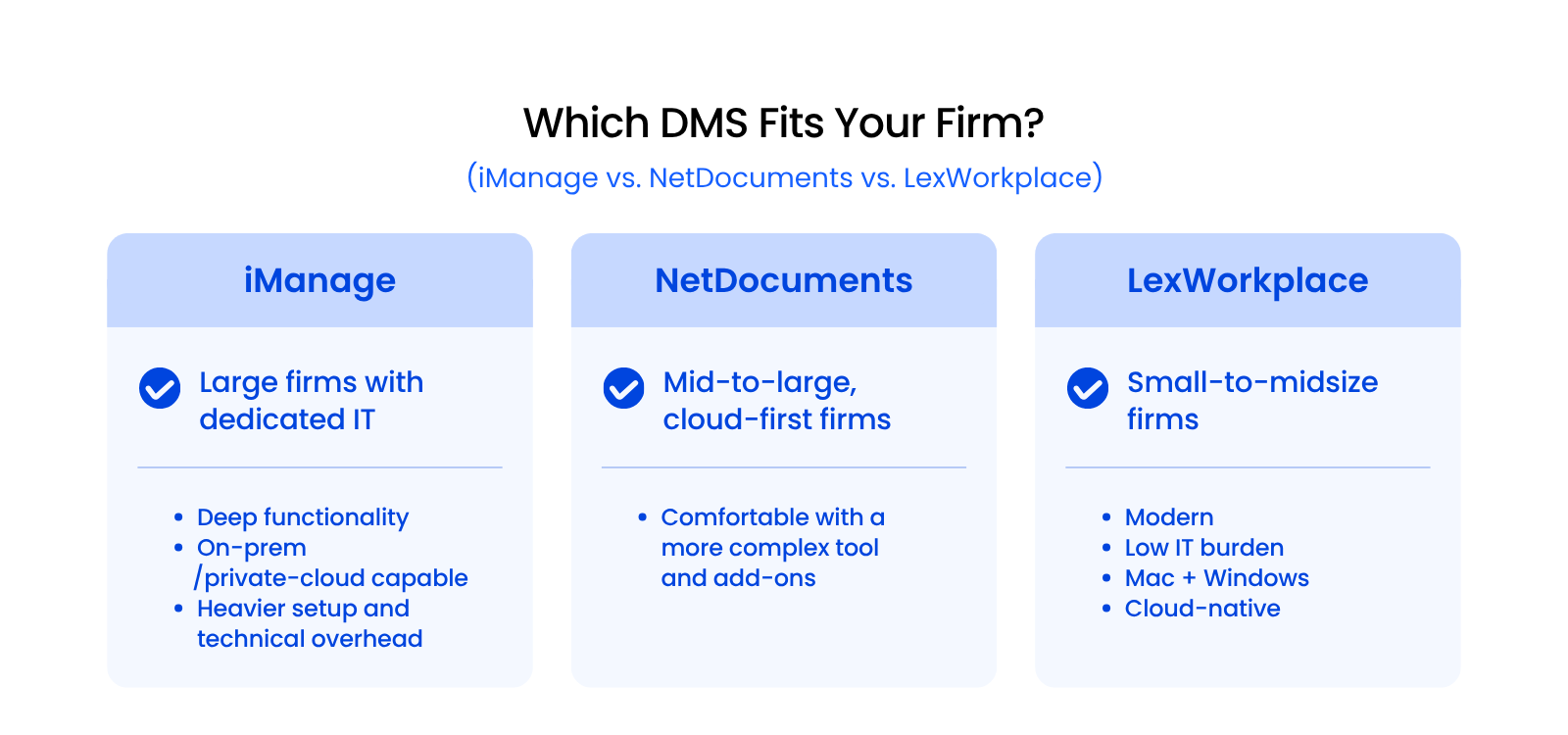
Three-column guide showing iManage fits large firms with IT, NetDocuments fits mid-to-large cloud-first firms, LexWorkplace fits small-to-midsize firms.
  • Choose iManage if you’re a large firm with dedicated IT staff or a private-cloud requirement, and you need the deepest functionality available. Be ready for the setup and technical overhead that comes with it.

  • Choose NetDocuments if you’re a mid-to-large, cloud-first firm comfortable managing a more complex tool and paying for the add-ons that round it out.

  • Choose LexWorkplace if you’re a small-to-midsize firm that wants a modern, cloud-native DMS with low IT burden, native Mac and Windows support, and the core capabilities of a traditional system without the weight.

The honest answer is that iManage and NetDocuments are excellent systems that many firms don’t need at full scale. If your firm doesn’t have dedicated IT, the power of a legacy platform can turn into friction fast.

The old DMSs like Worldox and NetDocuments do a lot, but they’re dinosaurs — unintuitive and heavy-handed. We wanted the simplicity of Google Drive with the capabilities of an old-school DMS.

— Dennis Dimka, Founder, LexWorkplace

Pricing and Cost Considerations

iManage and NetDocuments are usually sold through third-party resellers, which means the real cost includes implementation, consultant time, and add-ons — not just a license fee. Budgeting for either one means looking past the per-user number.

A few cost layers tend to stack up with legacy platforms:

  • Licensing. The base per-user or per-seat fee, typically negotiated through a reseller rather than published — our breakdown of NetDocuments pricing shows how that plays out in practice.

  • Implementation and consultants. Setup, configuration, and migration are often handled by a third-party partner, billed separately from the software.

  • Add-on modules and integrations. Some capabilities run through optional desktop add-ins (NetDocuments’ ndOffice and ndMail, for example), which install per machine and add IT overhead. Larger deployments may also layer on modules beyond the base platform.

  • Ongoing support. Larger firms often need dedicated IT or a reseller relationship to keep the system healthy.

A modern cloud DMS tends to fold more of this into a single, transparent subscription. When you compare costs, compare the whole picture — not just the license. The system with the lower sticker price isn’t always the cheaper one to run.

FREE BUYER’S GUIDE 

See how 7 legal DMS platforms really compare

  • All 7 platforms scored across the 8 criteria that matter for law firms
  • Real pricing — including the numbers iManage and NetDocuments won’t publish
  • 12 questions to ask any vendor before you sign

iManage: Strengths, Tradeoffs, and Who It’s For

iManage is a long-established document management system built for large firms with the IT resources to run it — our full iManage review digs into how that plays out day to day. It’s one of the deepest, most capable platforms in legal, and it’s trusted by many of the largest firms in the country.

Its strengths are real:

imlogo-min

iManage Work

Full-featured enterprise DMS for large law firms and organizations with dedicated IT resources.

Best for: Large firms (50+ users) with dedicated IT staff, existing iManage relationships, or complex governance requirements.

PRICING

Contact for pricing

FREE TRIAL

No

CLOUD-NATIVE

Yes

MAC SUPPORT

Limited

STRENGTHS

  • Deep functionality built for high-volume enterprise environments

  • Cloud-native, on-premise, and hybrid deployment options

  • Robust AI suite (Ask iManage, Insight+, MCP server) for enterprise knowledge management

  • Comprehensive compliance and governance tooling

LIMITATIONS

  • No public pricing — requires a reseller engagement to evaluate or purchase

  • Specialist IT consultant required for implementation and administration

  • Heavy overhead for smaller practices — complexity exceeds the requirements of most firms under 50 users

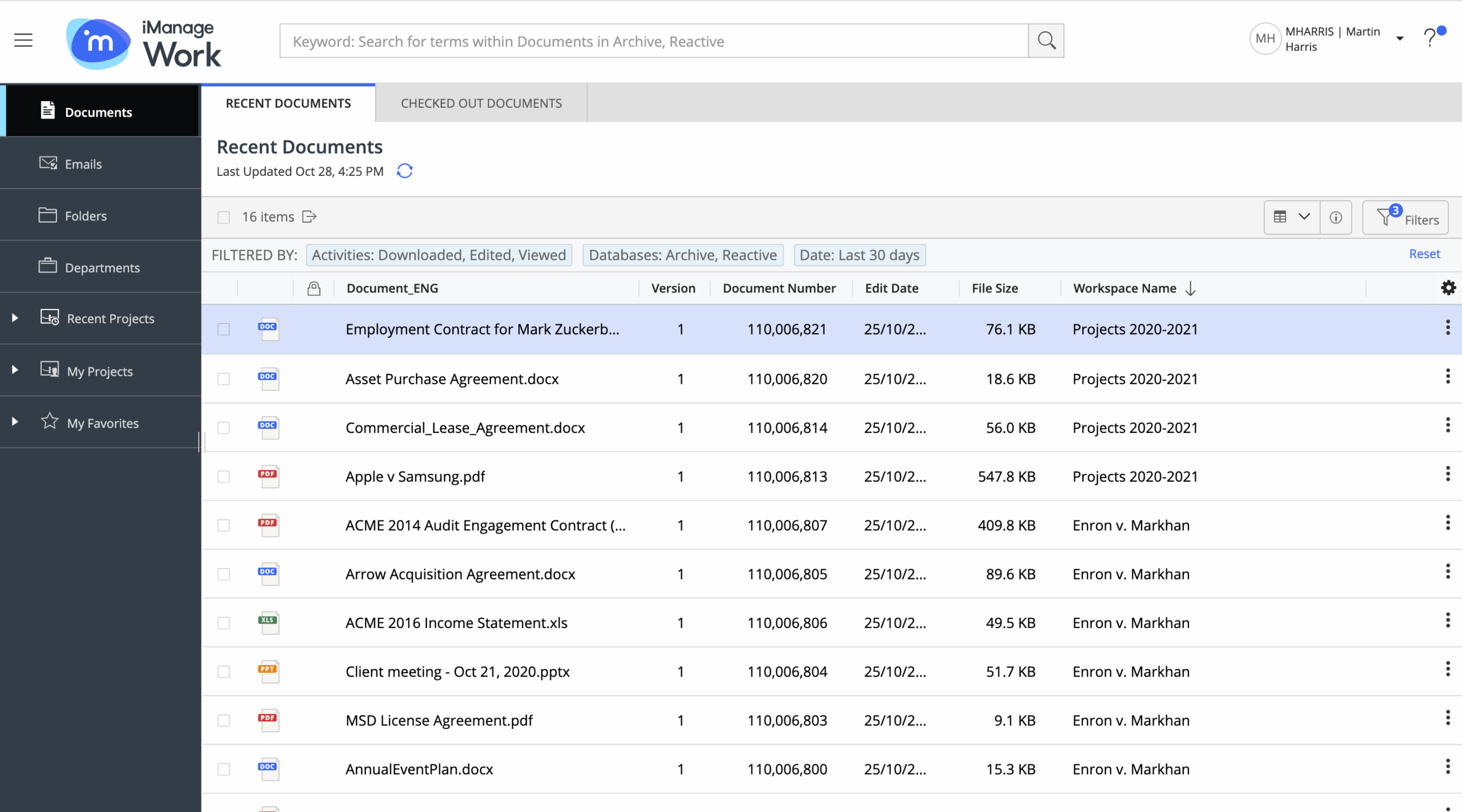
PRODUCT SCREENSHOT

The tradeoffs are just as real. iManage carries significant setup and technical overhead, and its interface reflects its age and depth. Mandatory document profiling — required fields on every save — is powerful for large firms with strict filing discipline and tedious for everyone else.

NetDocuments: Strengths, Tradeoffs, and Who It’s For

NetDocuments is a web-based document management system built for mid-to-large firms that want cloud storage and are comfortable with a more complex tool. It was cloud-first earlier than most legacy competitors, and that architecture is its main advantage.
NetDocuments

Cloud-native legal DMS with strong compliance credentials and a broad enterprise legal customer base.

Best for: Mid-to-large firms (20+ users) that need a cloud-native enterprise DMS and are comfortable with a reseller implementation model.

PRICING

~$50–65/user

FREE TRIAL

No

CLOUD-NATIVE

Yes

MAC SUPPORT

Limited

STRENGTHS

  • Cloud-native with no server infrastructure required
  • Strong compliance and security posture
  • Broad enterprise legal market presence
  • Natural migration destination for Worldox users following the 2023 acquisition

LIMITATIONS

  • OCR doubles your storage — every OCR’d file is saved as a separate version, inflating storage consumption and overage costs
  • Limited Mac support — ndOffice is Windows-only; Mac users rely on browser access or third-party tools (ndClick, ndSync)
  • Third-party consultant required for implementation

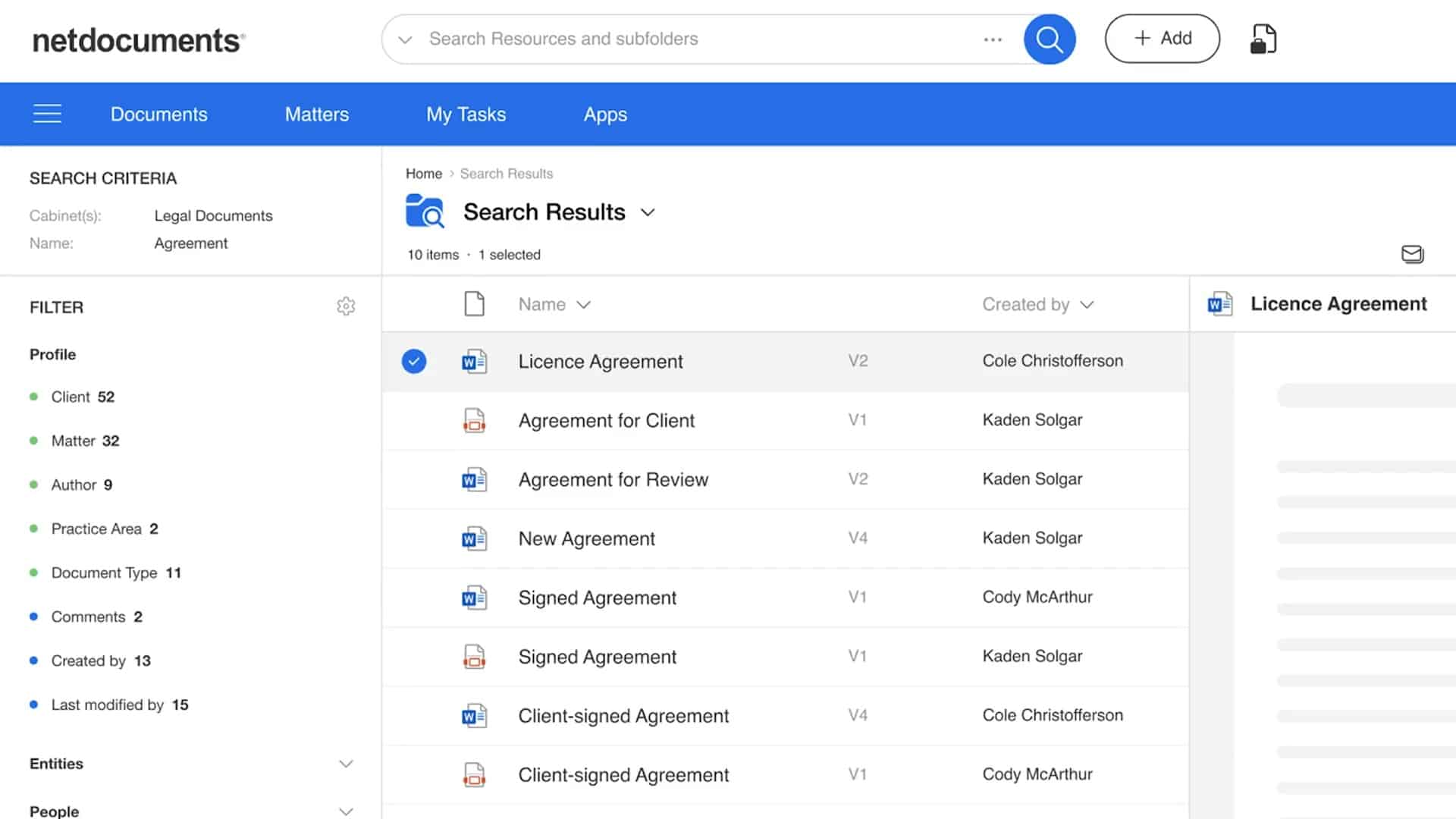
PRODUCT SCREENSHOT

netdocuments screenshot

The tradeoffs center on complexity and IT overhead. Office and Outlook integration runs through NetDocuments’ Microsoft 365 add-in, deployed through Microsoft 365, with optional desktop add-ins (ndOffice and ndMail) for advanced features. The desktop tools install per machine, which adds some IT overhead.

NetDocuments uses a version model where users manage document versions as they work — worth walking through in a demo if version control matters to your firm.

WHAT’S NEXT

ARTICLE
Best Document Management Software for Law Firms

FREE ASSESSMENT
Get a Free Document & Email System Audit

FREE DEMO
Get a Free Demo of LexWorkplace

FAQ

Yes — both are enterprise-grade legal document management systems aimed at larger firms, with workspace-based organization, document profiling, and deep functionality. The main difference is deployment: NetDocuments is cloud-only, while iManage also offers on-premise and hybrid options.

iManage competes with NetDocuments at the enterprise end of the market, and with modern cloud-native systems like LexWorkplace for small-to-midsize firms. Worldox was a longtime competitor in the on-premise space before its acquisition by NetDocuments.

NetDocuments competes most directly with iManage among large firms, as our NetDocuments review lays out in detail. For smaller and midsize firms, cloud-native platforms like LexWorkplace are the more common alternative, since they deliver core DMS capabilities without the implementation overhead.

NetDocuments doesn’t publish a current law-firm-only count, but the company has reported serving more than 4,000 law firms, corporate legal departments, and public-sector organizations. If exact adoption numbers matter to your evaluation, ask the vendor directly during a demo.

For most small firms, neither iManage nor NetDocuments is the best fit — both are built for larger firms with IT resources and carry setup and cost overhead that’s hard to justify at small scale. A modern cloud-native DMS like LexWorkplace usually serves a small firm better, with lower IT burden and the core capabilities a firm actually uses.

Last Updated: July 23rd, 2026 / Categories: Legal Document Management /

As the founder and CEO of Uptime Legal, I've had the privilege of guiding our company to become a leading provider of technology services for law firms.

Our growth, both organic and through strategic acquisitions, has enabled us to offer a diverse range of services, tailored to the evolving needs of the legal industry.

Being recognized as an Ernst & Young Entrepreneur of the Year Finalist and seeing Uptime Legal ranked among the Inc. 5000 list of fastest-growing private companies in America for eight consecutive years are testaments to our team's dedication.

At Uptime Legal, we strive to continuously innovate and adapt in the rapidly evolving legal tech landscape, ensuring that law firms have access to the most advanced and reliable technology solutions.