Worldox is going away. On-premise support ends December 31, 2026, and Worldox Cloud already shut down back in 2023. If your firm still runs Worldox, you’ve got a real deadline and a real decision in front of you.

You’ve probably heard NetDocuments acquired Worldox and is steering firms onto its own platform. That’s one path. For a lot of small and mid-sized firms, taking it by default is a mistake.

This is your map of the real replacement options — what to look for, how the leading document management systems for law firms honestly compare, and where each one fits.

Worldox End-of-Life: What’s Happening and When

Worldox on-premise support ends December 31, 2026, and Worldox Cloud was discontinued back in 2023. If your firm is still running Worldox GX3 or GX4, the clock is now the most important fact in your technology planning.

This isn’t a rumor or a far-off “someday.” It’s a scheduled end date, and the 2023 Cloud shutdown already showed how it plays out.

Here’s the timeline that matters:

  • 2023: Worldox Cloud was discontinued, leaving cloud users to migrate.

  • December 31, 2026: Worldox on-premise (GX3/GX4) reaches end-of-life.

After that date, end-of-life means more than a lack of new features. It means:

  • No further product updates or patches.
  • No vendor support when something breaks.
  • Growing security and compliance risk as the software ages on an unsupported server.

Staying put past the deadline isn’t a neutral choice. An aging on-premise system keeps accumulating risk while you wait — remote access degrades, the server still has to be managed, and law firms aren’t in the business of running technology. That risk lands on your firm.

The good news is you have time to choose well if you start now. The rest of this guide walks through how.

Why Worldox Firms Are Being Pushed to NetDocuments

NetDocuments acquired Worldox, and its end-of-life migration path points firms toward NetDocuments’ own platform. When you reach out about what’s next, the recommended answer tends to be the product the same company sells.

That makes business sense for NetDocuments. Owning the product you’re migrating off of means owning the migration, and the easiest customer to win is one who’s already being sent your way.

It doesn’t make NetDocuments the right answer for your firm by default.

What Law Firms Miss

NetDocuments owns Worldox — so the same company managing your end-of-life migration also sells the platform it’s steering you toward. That’s worth knowing before you treat it as the default.

NetDocuments is a capable, secure, enterprise-grade system. The real question is whether a small or mid-sized firm should inherit an enterprise platform built for much larger organizations — or choose a system built for a firm your size. You’re allowed to evaluate the field instead of following the funnel.

That’s what the rest of this page helps you do: look at the honest options, compare them side by side, and decide on your own terms.

Is Your Firm’s Document Chaos Costing You?

Find out where documents and emails are falling through the cracks — in 5 minutes.

What to Look for in a Worldox Replacement

The right Worldox replacement should be cloud-native, run natively on both Windows and Mac, and remove the on-premise server, forced profiling, and third-party-consultant friction Worldox firms already know too well.

Worldox firms tend to share the same frustrations, so the criteria below come straight from what made the old system painful. Use them to evaluate any option you’re considering:

  • True cloud-native. No on-premise server to buy, patch, or back up. Access your documents securely from anywhere, without a VPN.

  • Native Windows and Mac. A real Mac experience, not a Parallels workaround or a stripped-down web view. Your Mac attorneys should work the same way your Windows users do.

  • Intuitive interface. A system your team can actually learn, so you’re not dependent on a specialist for everyday tasks.

  • No forced profiling. You shouldn’t have to fill out a metadata form on every single document just to save it.

  • Automatic encryption. Data encrypted in transit and at rest by default, not as an add-on.

  • Geographic data redundancy. Your data replicated across multiple data centers so a single failure can’t wipe it out.

  • No required outside consultant. Migration and support handled by the people who actually built the software.

  • Transparent pricing. Published, predictable pricing you can evaluate without a sales runaround.

  • Flexible term. A month-to-month option, so the vendor has to keep earning your business.

That last pair — who handles your migration, and whether you’re locked in — separates the systems that respect your firm from the ones that don’t. Score every option against this list. The criteria favor cloud-native systems, and that’s the point — it’s where the market has moved for firms your size.

Your Real Options as Worldox Ends

For most firms leaving Worldox, the real options are NetDocuments, iManage, or a cloud-native document management system built for small and mid-sized firms. A handful of other tools fit narrower needs, but those three define the decision.

A quick definition first.

A legal document management system stores and organizes your documents and email by client and matter, with full-text search, version control, and profiling — well beyond what a file server or basic cloud storage can do. The legacy DMS products have been around a long time but show their age, and basic cloud storage was never built for legal work — the real question is which option fits a firm your size.

The three cards below use the same criteria so you can compare them honestly, side by side.
Enterprise Cloud DMS

NetDocuments

Cloud-native legal DMS with strong compliance credentials and a broad enterprise legal customer base.

Best for: Mid-to-large firms (20+ users) that need a cloud-native enterprise DMS and are comfortable with a reseller implementation model.

PRICING

~$50–65/user

FREE TRIAL

No

CLOUD-NATIVE

Yes

MAC SUPPORT

Limited

STRENGTHS

  • Cloud-native with no server infrastructure required
  • Strong compliance and security posture
  • Broad enterprise legal market presence
  • Natural migration destination for Worldox users following the 2023 acquisition

LIMITATIONS

  • OCR doubles your storage — every OCR’d file is saved as a separate version, inflating storage consumption and overage costs
  • Limited Mac support — ndOffice is Windows-only; Mac users rely on browser access or third-party tools (ndClick, ndSync)
  • Third-party consultant required for implementation

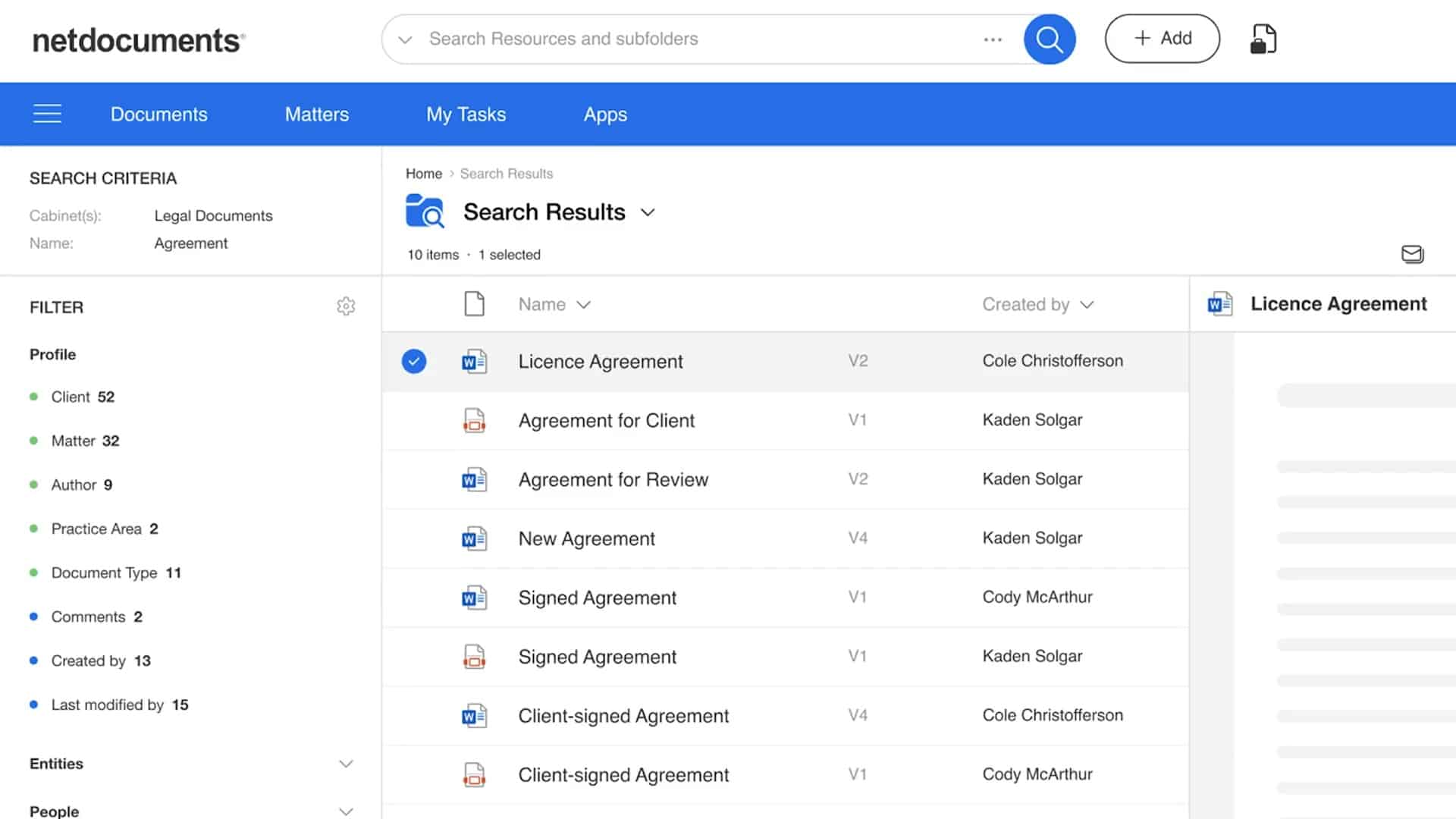
PRODUCT SCREENSHOT

netdocuments screenshot
Enterprise DMS
imlogo-min

iManage Work

Full-featured enterprise DMS for large law firms and organizations with dedicated IT resources.

Best for: Large firms (50+ users) with dedicated IT staff, existing iManage relationships, or complex governance requirements.

PRICING

Contact for pricing

FREE TRIAL

No

CLOUD-NATIVE

Yes

MAC SUPPORT

Limited

STRENGTHS

  • Deep functionality built for high-volume enterprise environments

  • Cloud-native, on-premise, and hybrid deployment options

  • Robust AI suite (Ask iManage, Insight+, MCP server) for enterprise knowledge management

  • Comprehensive compliance and governance tooling

LIMITATIONS

  • No public pricing — requires a reseller engagement to evaluate or purchase

  • Specialist IT consultant required for implementation and administration

  • Heavy overhead for smaller practices — complexity exceeds the requirements of most firms under 50 users

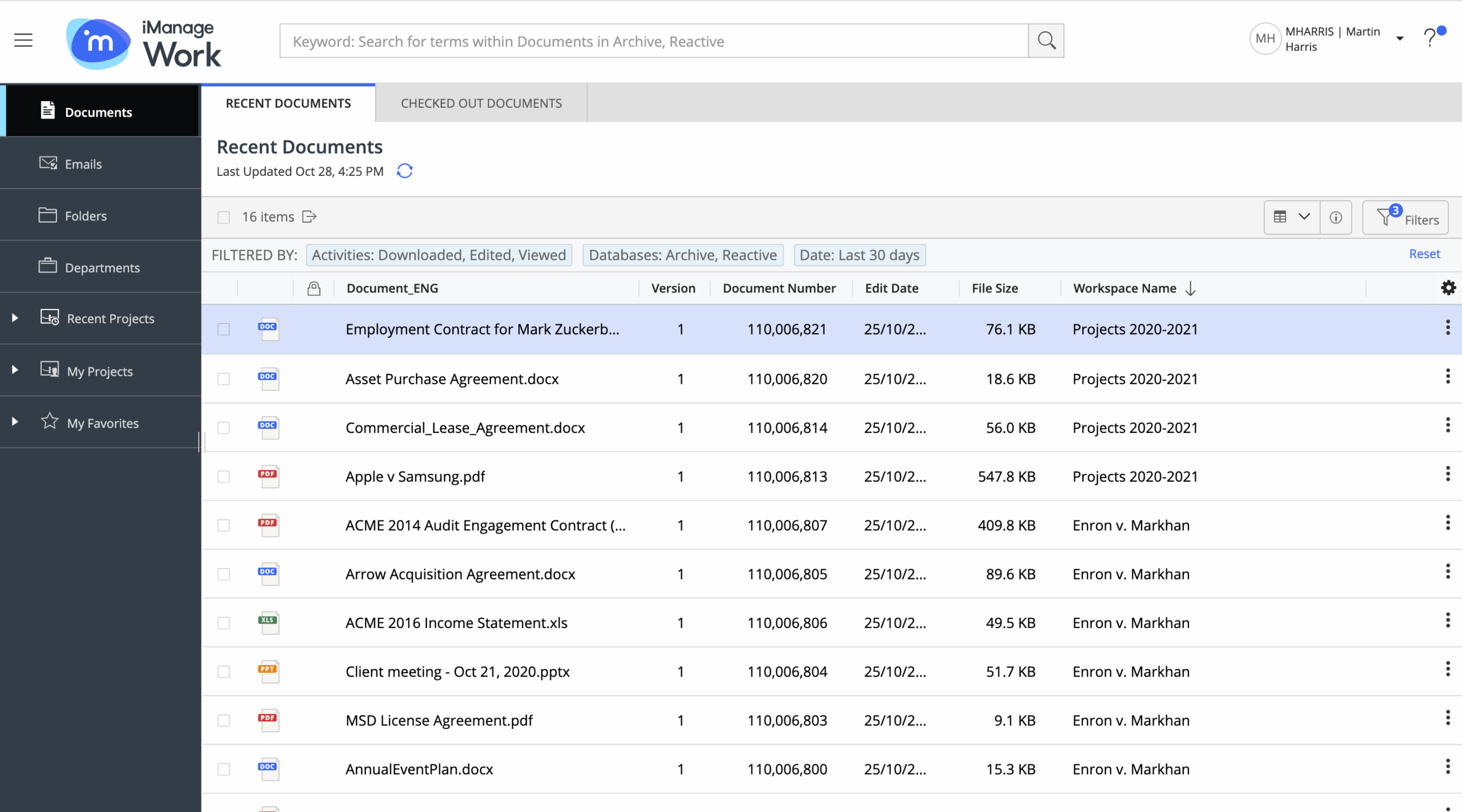
PRODUCT SCREENSHOT

Recommended
LexWorkplace Logo

LexWorkplace

Cloud DMS built exclusively for law firms

Best for: Cloud-ready law firms of 2–75 users wanting a purpose-built DMS with full Mac + Windows support and built-in AI

PRICING

From $395/mo

FREE TRIAL

Yes

CLOUD-NATIVE

Yes

MAC SUPPORT

Full

STRENGTHS

  • Full Windows + Mac — no workarounds, no virtual desktops

  • Integrated Outlook email management

  • Document AI + AI-powered search included on all plans

  • Matter-centric organization out of the box

  • Sold and implemented directly — no reseller required

LIMITATIONS

  • Team-focused — may exceed what a solo practitioner needs

  • Cloud-only — no on-premise deployment option

“We wanted LexWorkplace to be like the simplicity and lightness of a Google Drive, but the capabilities of an old-school DMS.”
— Dennis Dimka, CEO, Uptime Legal

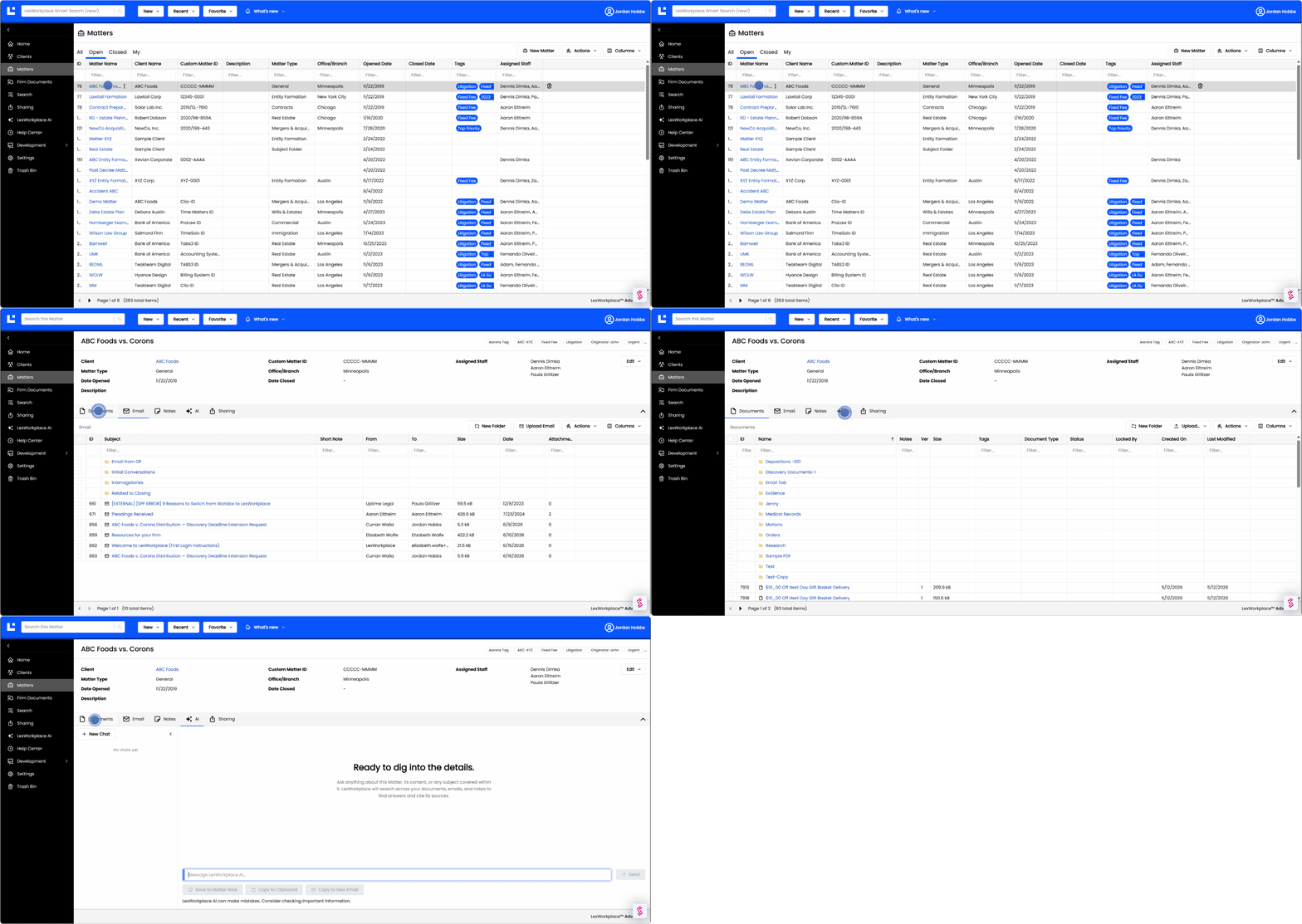
PRODUCT SCREENSHOT

lexworkplace app gif

Other Options (ProLaw, LEAP, SharePoint, Revver, eDOCS)

A few other systems fit narrower needs:

  • ProLaw combines practice management, document management, and accounting in one suite, while **LEAP** pairs practice management with document management and assembly — useful if you want everything in a single product.

  • SharePoint can serve as a document store for firms already standardized on Microsoft, but it needs heavy customization to work for legal.

  • Revver and eDOCS are general-purpose document platforms used across industries, including some law firms.

For most Worldox firms, the decision still comes back to the three primary options above.

Is NetDocuments Right for Your Firm?

NetDocuments is a strong fit for **larger firms with dedicated IT**, but its cost, browser-based workflow, and lack of a native client/matter structure make it a difficult fit for many smaller firms. It’s worth being honest about both sides, because this is the option you’re most likely to be pushed toward.

What NetDocuments does well:

  • Security and compliance. Enterprise-grade security trusted by large firms and corporate legal departments.

  • Scale and features. A deep feature set and the resources of a major vendor behind it.

  • Established track record. A long history and a large installed base in legal.

Where firms run into friction:

  • Organization. It doesn’t impose a native client/matter structure the way legal-first tools do, so smaller firms often have to build and maintain their own.

  • Cost and transparency. Pricing is quote-based, and firms cite cost as a recurring concern.

  • Day-to-day experience. The browser-based workflow draws complaints about being harder to navigate than expected.

Two real user reviews capture the split:

“Difficult to use, expensive, but secure.” — 5/5, via Capterra

“Useful, but hard to navigate.” — 2/5, via Capterra

When is NetDocuments the right call? If you’re a larger firm with in-house IT, enterprise security requirements, and the budget to match, NetDocuments is a legitimate, capable choice. For a small or mid-sized firm that wants to be productive without a dedicated IT team, the fit is usually weaker.
iManage vs NetDocuments

We perform a side-by-side comparison of iManage vs. NetDocuments for law firms, including features, implementation, data security and more.

Worldox: A Quick Review

Worldox is an on-premise document management system long used by law firms, built around a Windows-centric desktop client. For years it did its core job well — organizing, classifying, and searching documents far better than a folder-based file server.

The reasons firms are leaving are the same reasons it’s reaching end-of-life:

  • On-premise only. It runs on a server your firm owns and maintains, with no native cloud.

  • Windows-centric. Its GX4 client leans heavily on Windows, leaving Mac firms with workarounds.

  • Outsourced migration and training. Worldox relied on third-party consultants for migration and training, with mixed results.

  • Opaque pricing. It never published pricing, so costs and migration fees were hard to predict.

Worldox was a capable product in its time, and the wrong one to stay on past 2026. A fuller breakdown lives in our Worldox review if you want the detail.

What a Modern Document Management System Should Do

A modern document management system secures, organizes, and retrieves your firm’s documents and email from the cloud, without an on-premise server to manage. Storage is just the floor — the value is in everything the system does on top of it.

A cloud-based legal DMS should give your firm:

  • Stronger security. Encryption in transit and at rest, multi-factor authentication, and geographically redundant backups.

  • Work from anywhere. The same access to client and firm documents in the office or out of it.

  • No server to manage. No hardware to own, patch, or replace, and lower IT cost as a result.

  • Less risk of data loss. Automatic replication across multiple data centers.

  • Automatic updates. New features and fixes without manual installs on every machine.

  • Scalability. Add users and storage as you grow, and pay for what you use.

Migrating Off Worldox: How to Switch

Migrating off Worldox is a planned data-and-training project that goes smoothest when you start well before the December 2026 deadline. The firms that struggle are the ones that wait until support is gone and then rush.

A good migration comes down to a few things:

  1. Start early. Give yourself months, not weeks, to move data and train your team without downtime pressure.
  2. Map your data. Know what you’re moving — matters, documents, email, and metadata — before you begin.
  3. Choose a provider that owns the process. Look for a vendor that runs its own onboarding instead of handing you to an outside consultant.

That last point is where many DMS migrations go wrong, and it’s worth weighing heavily.

A lot of document management products farm out migration to outside consultants. We do our own onboarding — and everything we do is month to month, so we know we need to deliver.

— Dennis Dimka, Founder, LexWorkplace

Waiting also carries its own cost, which we cover in why law firms shouldn’t delay a DMS migration. LexWorkplace handles migration and onboarding directly, with no third-party consultant in the middle.

Bring Law and Order to Your Documents

LexWorkplace Includes::

  • Document Profiling / Metadata

  • Structured by Client/Matter

  • Organize With Folders and Tags

  • Save Emails to Matters

  • Built-In Version Management

  • Add Notes to Docs & Email

  • Automatic, Integrated OCR

Make the Deadline Work in Your Favor

Worldox is ending, and the deadline is a chance to fix what the old system made you live with. You’ve got time to choose deliberately if you start now.

Weigh how each option actually fits your firm’s size, your team, and the way you work day to day. NetDocuments may be right for some firms. A cloud-native system built for small and mid-sized firms will be right for many more. The firms that come out of this ahead will be the ones that chose on purpose.

WHAT’S NEXT

ARTICLE
Best Document Management Software for Law Firms

FREE ASSESSMENT
Get a Free Document & Email System Audit

FREE TRIAL
Get a Free Demo of LexWorkplace

Worldox Alternatives — Frequently Asked Questions

Worldox on-premise reaches end-of-life, so you won’t get product updates, patches, or vendor support after that date. Your installation will keep running, but it’ll age on an unsupported server with growing security risk.

No — NetDocuments owns Worldox and steers migrations toward its own platform, but you’re free to choose any system. For many small and mid-sized firms, a cloud-native DMS fits better than an enterprise platform.

No — Worldox Cloud was discontinued in 2023, which is why cloud users already had to migrate. The on-premise version follows at the end of 2026.

Look for a cloud-native system with native Windows and Mac support, automatic encryption, transparent pricing, and migration handled by the vendor rather than an outside consultant. Those criteria fix the most common Worldox frustrations.

Plan for months rather than weeks, depending on your firm’s size and data volume. Starting early gives you room to move data and train your team without downtime pressure.

It can be, for larger firms with dedicated IT and enterprise needs. Smaller firms often find it costly and harder to navigate, with no native client/matter structure.

A cloud-native, matter-centric DMS built for firms your size — like LexWorkplace — usually fits better than inheriting an enterprise system. The right choice still depends on your team, your budget, and how you work.

Last Updated: July 10th, 2026 / Categories: Legal Document Management /

As the founder and CEO of Uptime Legal, I've had the privilege of guiding our company to become a leading provider of technology services for law firms.

Our growth, both organic and through strategic acquisitions, has enabled us to offer a diverse range of services, tailored to the evolving needs of the legal industry.

Being recognized as an Ernst & Young Entrepreneur of the Year Finalist and seeing Uptime Legal ranked among the Inc. 5000 list of fastest-growing private companies in America for eight consecutive years are testaments to our team's dedication.

At Uptime Legal, we strive to continuously innovate and adapt in the rapidly evolving legal tech landscape, ensuring that law firms have access to the most advanced and reliable technology solutions.