Table of Contents
Somewhere in your firm’s inbox sits five years of client matter history. Nobody decided how long to keep it. Nobody decided when it’s safe to let it go.
Most firms never formalize an email retention policy until something forces the question: a malpractice insurance renewal, a closed-file review, or a partner realizing years of matter email live in personal inboxes with no plan behind them.
This guide breaks down what your firm is actually obligated to keep, how retention differs from archiving, and how a matter-centric document management system turns a vague obligation into a policy you can actually follow.
Retention requirements vary by state, practice area, and matter type. This article covers general principles and ABA guidance. Talk to your state bar and legal counsel before setting your firm’s specific policy.
Why Does Email Retention Matter for Law Firms?
Email tied to a client matter is a client record, and it carries the same retention obligations as the rest of the matter file. That’s true whether the email sits in a shared inbox, a paralegal’s personal account, or any of the other common problems with managing email in law firms.
Three things are riding on how you handle it:
None of that requires a compliance department: it requires treating email as part of the matter file instead of as disposable correspondence.
What’s the Difference Between Email Retention and Archiving?
Retention and archiving solve two different problems. Retention keeps email accessible for as long as your firm is required to hold it, and archiving moves inactive email into lower-cost storage without losing the ability to retrieve it.
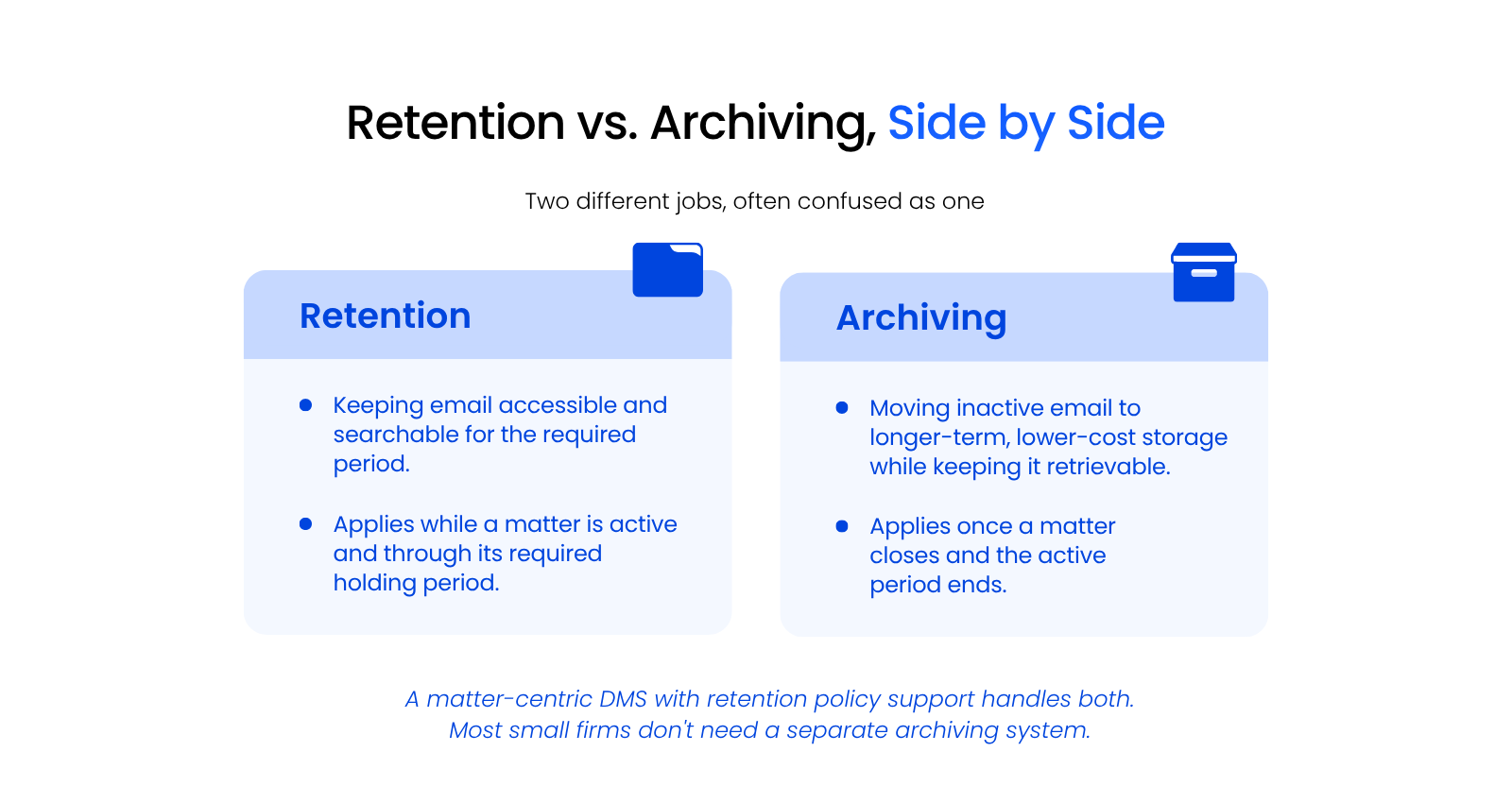
Retention applies while a matter is open and through whatever holding period your policy sets after it closes. The email needs to stay searchable, because you might need to pull it up for a client question, a bar complaint, or a malpractice defense.
Archiving applies once that active period ends. The email still exists, but it moves out of your day-to-day working environment into storage built for long-term, low-frequency access.
If your firm is small or midsize, you probably don’t need separate archiving infrastructure. A matter-centric document management system that supports retention policy handles both jobs in one place, which is one less system to configure, monitor, and eventually replace.

What ABA and State Bar Rules Require
ABA Model Rule 1.15 establishes a five-year baseline for retaining client records, including matter-related email, after the termination of representation. Treat that number as a starting point. Most firms should plan for more, especially in higher-risk practice areas.
Several states extend that baseline to six or seven years, and some practice areas push it much further:
General Email and Client Record Retention Guidance by Practice Area
| Record Type | General Retention Guidance | Notes |
|---|---|---|
| Client files (general) | 5-7 years after representation ends | Check your state’s specific rule |
| Financial records | 7 years | Often tied to tax and audit requirements |
| Criminal matters | Life of the client | Some jurisdictions require indefinite retention |
| Matters involving minors | Until age of majority, plus applicable period | Period varies by state |
| Trust and estate matters | Often longer than general files | Varies significantly by jurisdiction |
The ABA Baseline: Five Years After Representation Ends
The five-year post-representation baseline in ABA Model Rule 1.15 is the floor most state bar rules build on, not the ceiling your firm should plan around.
Rule 1.15 was written with client property and trust accounting in mind, and most state bars have extended its logic to the broader client file, including correspondence.
State Bar Variations and Practice Area Exceptions
Several states require six or seven years instead of five, and some set no fixed period at all for certain practice areas. Criminal defense, probate, tax, and matters involving minors are the practice areas most likely to require retention well beyond the general baseline, sometimes indefinitely.
The Malpractice Defense Reason to Retain Longer
The applicable malpractice statute of limitations, not the bar-rule minimum, is usually the number that should actually set your firm’s retention period. In many states, that limitations period runs longer than the ethical retention floor.
A firm that retains only the bar-rule minimum may have already discarded the records it would need to defend itself, and no amount of email search in a legal document management system can retrieve what’s already gone.
Legal Holds: When Normal Retention Rules Are Suspended
A legal hold is the obligation to preserve every communication relevant to a matter once litigation is reasonably anticipated, regardless of what your normal retention schedule says. That obligation kicks in before a lawsuit is filed. It starts the moment litigation becomes a realistic possibility.
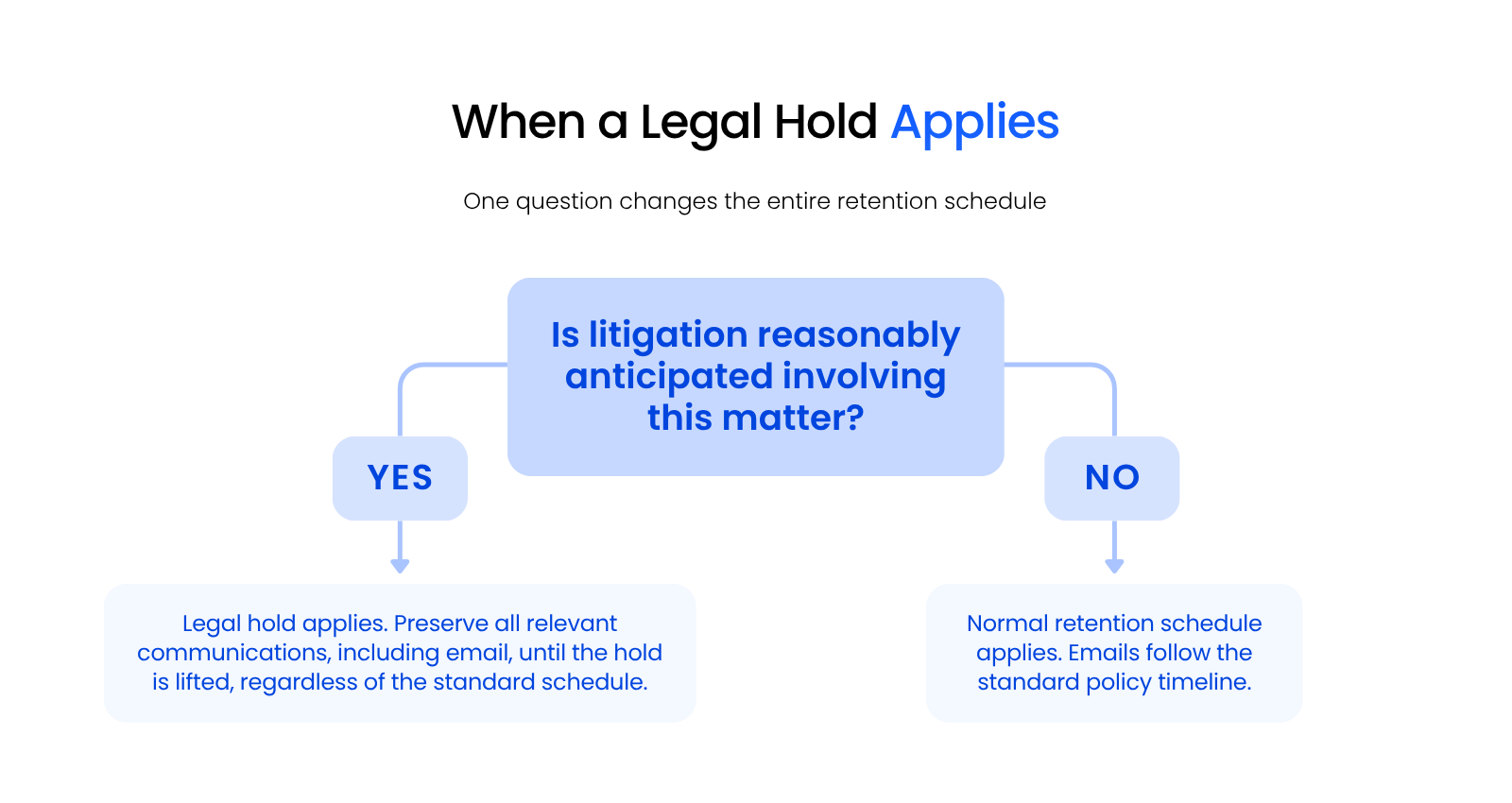
Email sitting in a personal inbox is especially vulnerable here. If your firm runs an automatic deletion schedule, or an attorney manually clears out old messages, a legal hold can be violated without anyone realizing it happened until it’s too late to fix.
A document management system with legal hold support flags the affected matter and suspends deletion across every email filed to it, something ad hoc inbox management can’t do.
Matter-Centric Email Retention: The Right Way to Think About It
A matter-centric approach to email retention treats every email tied to a case as part of that matter’s record, not as a message sitting in an inbox. That shift changes how retention actually gets applied.
Once you’re thinking in matters instead of inboxes, a few things follow:
Getting matter email into your document management system as work happens, covered in how you file email to a matter in Outlook, is what makes matter-centric retention possible instead of theoretical.
What a Reasonable Retention Policy Looks Like for a Small Firm
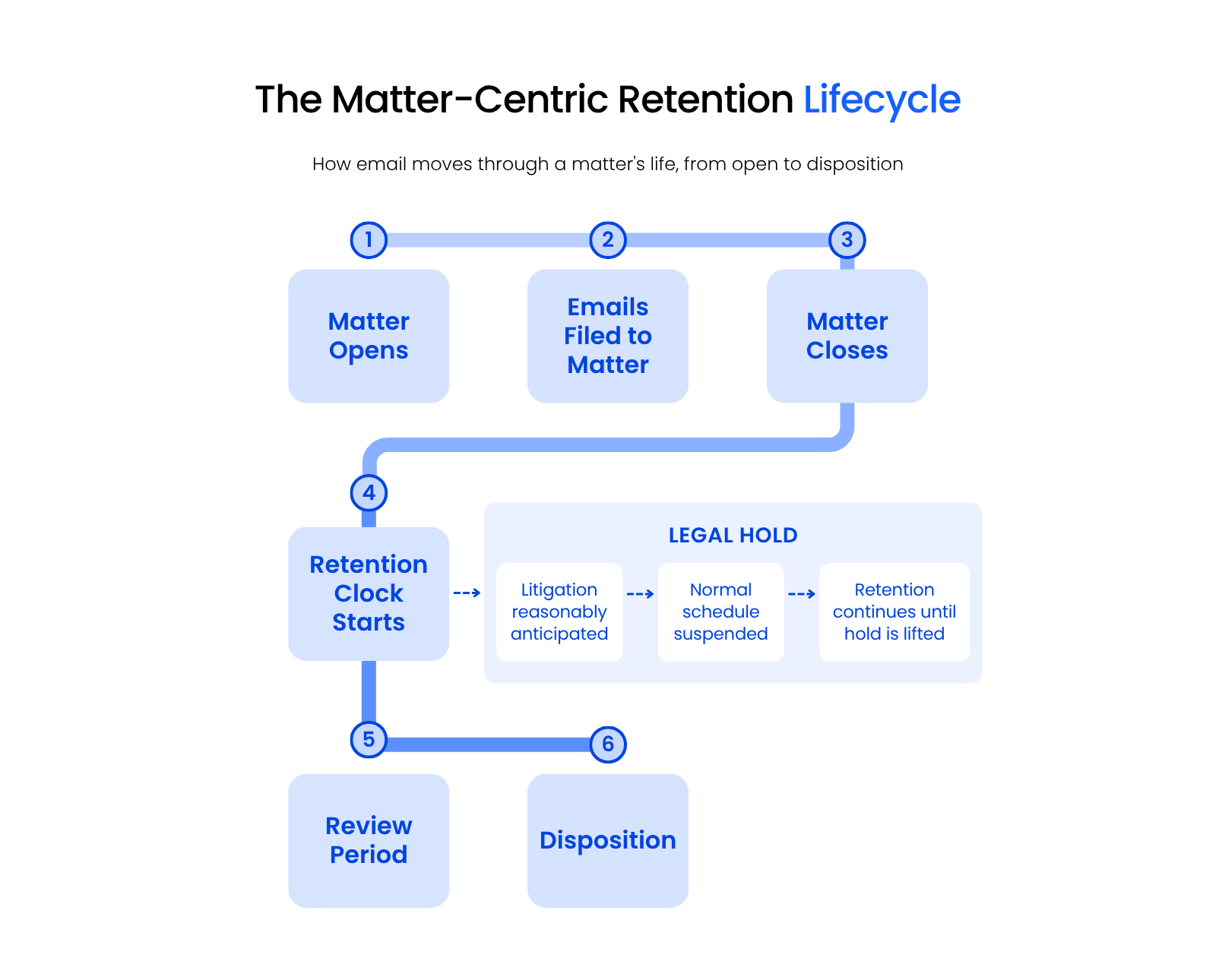
A reasonable retention policy for a small firm has four parts: a defined retention period for each practice area, a rule for applying that period when a matter closes, a process for legal holds, and a review step before disposition.
None of these require a dedicated compliance team: they require a decision, made once, that your firm actually follows.
- 1
Set a retention period for each practice area you handle, using your state bar’s guidance as the floor and the applicable malpractice statute of limitations as a check against it.
- 2
Apply that period at the matter level when a matter closes, so every email filed to the matter carries the same retention date instead of aging out individually.
- 3
Put a legal hold process in place before you need one, so a hold can be applied to a matter in minutes rather than during a scramble.
- 4
Review closed matters against their retention period before disposition, rather than deleting automatically or keeping everything by default.
The Risks of Having No Policy and of Keeping Everything Forever
Two failure modes create risk here: having no retention policy at all, and keeping every email indefinitely because nobody wants to decide what to delete.
No policy means inconsistent, ad hoc deletion that creates malpractice exposure and bar discipline risk the moment a client or a regulator asks what happened to a record. Keeping everything forever creates different problems: rising storage costs, more expensive and time-consuming eDiscovery, and potential conflicts with data minimization expectations under state privacy laws.
No Policy vs. Keep Everything Forever: Risk Comparison
| Risk | No Retention Policy | Keep Everything Forever |
|---|---|---|
| Malpractice exposure | High – records may be gone when needed | Low |
| Bar discipline risk | High – no defensible process | Low |
| eDiscovery cost | Variable | High – more data to review |
| Storage burden | Low | High |
| Data privacy compliance | Variable | Potential conflicts |
That’s the practical case for why email and document management should be integrated in the first place: a defined policy with appropriate periods is the only approach that avoids both extremes.
How LexWorkplace Supports Email Retention Policy
LexWorkplace applies retention settings at the matter level, so when a matter closes, your firm’s configured retention period determines when that email comes up for disposition review. You set the period once per practice area, and the system carries it forward automatically.
Because filing happens at the matter level too, every email tied to a case carries the same retention date as the rest of the matter file:
Build a Retention Policy Before You Need One
A defensible retention policy doesn’t require enterprise software or a compliance department. It requires a clear period for each practice area, a habit of applying that period when matters close, and a way to preserve email the moment litigation becomes a possibility.
Matter-centric email management makes that habit easy to keep, because retention lives with the matter instead of scattered across individual inboxes.
Start with your riskiest practice areas, confirm the periods with your state bar, and build the policy around how your firm already organizes its work.
WHAT’S NEXT